

The Geopolitical Fulcrum: Pakistan as the West’s Strategic Pivot in the Asian Century

Geography is the most unforgiving of the geopolitical realities. A nation can change its allies, its economy, and its political system, but it cannot change its location. In the grand chessboard of global hegemony, few nations occupy a more pivotal—and precarious—position than Pakistan. Bordering the rising superpower of China to the northeast, the regional hegemon of India to the east, the revolutionary state of Iran to the southwest, and the volatile gateway to Central Asia through Afghanistan to the northwest, Pakistan sits precisely at the tectonic fault lines of global power.
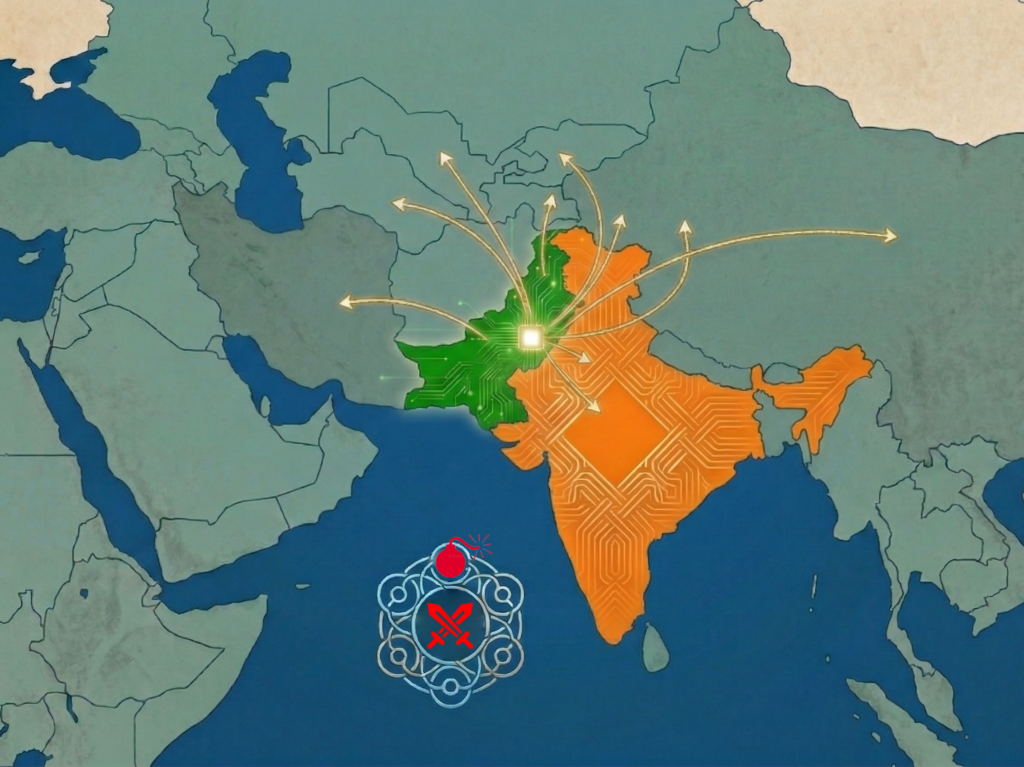
Historically and contemporarily, a compelling geopolitical narrative has emerged: the utilization of Pakistan by Western powers as a “center pivot.” In this paradigm, Pakistan is cast in the role of the strategic underdog—a heavily militarized but economically dependent state—leveraged by the West to check, balance, and disrupt the unfettered growth and integration of India, China, Iran, and the Central Asian republics. This article explores the architecture of this containment strategy, examining how Pakistan’s unique geography has been utilized to manage the Eurasian landmass.
Part I: The Anatomy of a Pivot State and the “Underdog” Dynamic
To understand Pakistan’s role, one must first understand the concept of the “pivot state.” Halford Mackinder’s foundational “Heartland Theory” posited that whoever controls Eastern Europe commands the Eurasian Heartland, and whoever commands the Heartland commands the world. Conversely, Nicholas Spykman’s “Rimland Theory” argued that it is the coastal fringes of Eurasia—the Rimland—that hold the key to global power, as they contain the populations, resources, and sea access necessary to contain the Heartland.
Pakistan is the ultimate Rimland state. It provides the shortest route from the landlocked heart of Eurasia (Central Asia and western China) to the warm waters of the Arabian Sea.
However, Pakistan possesses a unique characteristic that makes it susceptible to external alliances: it is a structural underdog. Born out of the chaotic partition of British India in 1947, Pakistan found itself with a fraction of the subcontinent’s resources, an unprotected border, and an immediate, existential rivalry with a much larger India. To survive, Pakistan’s strategic elite concluded that they needed an equalizer. They required offshore balancers to offset their geographic and economic vulnerabilities. The West, led by the United States, saw an opportunity. In need of a loyal proxy in South Asia to counter Soviet influence, a historic patron-client relationship was born. The West provided financial aid, advanced military hardware, and diplomatic top-cover; in return, Pakistan offered its geography, its intelligence apparatus, and its military to serve as a bulwark against forces deemed hostile to Western interests.
Part II: Balancing the Giant – The Containment of India
The most prominent and historical application of Pakistan as a Western pivot has been in relation to India. Following its independence, India, under Jawaharlal Nehru, championed the Non-Aligned Movement. However, its socialist-leaning economy and eventual Treaty of Peace, Friendship, and Cooperation with the Soviet Union in 1971 deeply concerned Washington.
To prevent the Indian subcontinent from falling entirely under Soviet hegemony, the West required a counterbalance. Pakistan was eager to play this role, joining Western-led defense pacts like the Southeast Asia Treaty Organization (SEATO) and the Central Treaty Organization (CENTO) in the 1950s. By arming Pakistan, the West effectively boxed India in. Instead of projecting power outward into the Indian Ocean or into Southeast Asia, India was forced to commit the vast majority of its military, economic, and strategic bandwidth to its western border.
This dynamic reached its zenith during the 1971 Indo-Pakistani War, where the Nixon administration famously dispatched the USS Enterprise to the Bay of Bengal in a show of force to intimidate India and support Pakistan.
Even as the Cold War ended, the paradigm persisted in modified forms. The West’s tacit acceptance (and occasional outright support) of Pakistan’s nuclear weapons program in the 1980s and 1990s was heavily influenced by the need to maintain an underdog capable of holding India in check. By ensuring that India remained bogged down in a perpetual, hyper-localized conflict over Kashmir and the broader Line of Control, Western powers effectively delayed India’s rise as a global, blue-water power.
Note of Contemporary Shift: While the current geopolitical climate has seen a Western pivot toward India (via mechanisms like the Quad) to counter China, the historical legacy of the West utilizing Pakistan to neutralize India’s regional dominance remains a textbook example of offshore balancing.
Part III: The Ultimate Prize – Severing the Chinese Silk Road
The premise of using Pakistan to counter China presents one of the most complex and fascinating paradoxes in modern geopolitics. Currently, Pakistan and China refer to each other as “iron brothers,” anchored by the $62 billion China-Pakistan Economic Corridor (CPEC). However, from a Western strategic perspective, Pakistan is the very geographic wedge needed to halt China’s ascendance.
China suffers from the “Malacca Dilemma”—a heavy reliance on the Strait of Malacca for its energy imports and export routes. In the event of a global conflict, the US Navy and its allies could blockade this strait, effectively choking the Chinese economy. To bypass this, Beijing has invested heavily in CPEC, creating a land corridor from its landlocked Xinjiang province directly to the deep-water Pakistani port of Gwadar on the Arabian Sea.
If Western powers intend to stop the growth of China, pulling Pakistan out of Beijing’s orbit is paramount. The strategy of using Pakistan to counter China involves several levers:
- Economic Leverage: Pakistan is perpetually in need of International Monetary Fund (IMF) bailouts, a body heavily influenced by the West. By leveraging these financial lifelines, the West can pressure Islamabad to slow down Chinese investments, increase transparency regarding Chinese debt, and prevent China from gaining dual-use (civilian and military) basing rights at Gwadar.
- Internal Fractures: The Balochistan province, where Gwadar is located, is site to a long-running separatist insurgency. While the West officially denies supporting these groups, geopolitical analysts note that internal instability in Pakistan inadvertently serves Western interests by making the region unviable for Chinese megaprojects.
- The Threat of Diplomatic Isolation: By threatening Pakistan with the stigma of being placed on the FATF (Financial Action Task Force) blacklists, the West can exert massive pressure on Islamabad’s foreign policy choices.
If the West can successfully pressure Pakistan to distance itself from Beijing, China’s grand strategy of Eurasian integration is severed at its most critical juncture. In this scenario, Pakistan is the ultimate underdog pawn capable of checkmating a superpower.
Part IV: The Western Flank – Boxing in Revolutionary Iran
Since the 1979 Islamic Revolution, the containment of Iran has been a cornerstone of Western foreign policy. Iran seeks to project its influence across the Middle East, establishing a “Shia Crescent” stretching from Tehran to the Mediterranean. To prevent Iran from achieving regional hegemony, the West has heavily relied on Sunni-majority states.
Pakistan shares a nearly 900-kilometer, highly porous border with Iran. As a Sunni-majority state with a powerful military, Pakistan serves as a natural, geographically contiguous counterweight to Iranian ambitions.
The Western strategy to use Pakistan to keep Iran in check operates on multiple fronts:
- Energy Blockade: One of the most glaring examples of Western pressure is the stalling of the Iran-Pakistan (IP) gas pipeline. Initially conceptualized to solve Pakistan’s chronic energy shortages using cheap Iranian gas, the project has been perpetually delayed by Islamabad. The primary reason? The threat of secondary sanctions from the United States. By forcing Pakistan to abandon the pipeline, the West successfully denies Iran a massive, lucrative market for its primary export, stifling Iranian economic growth.
- Military Deterrence: Pakistan has historically maintained deep military ties with Saudi Arabia (the West’s primary Arab ally against Iran). Pakistani troops have frequently been stationed in Saudi Arabia for training and protection. By aligning Pakistan’s military might with the Gulf monarchies, the West creates a two-front strategic dilemma for Tehran—forcing Iran to look eastward toward a nuclear-armed Pakistan, rather than focusing solely on the Middle East.
- Border Friction: The Sistan-Balochistan border region is restive, with Sunni militant groups occasionally launching attacks into Iran from Pakistani territory. While not officially sanctioned by the state, this ongoing friction forces Iran to expend vast resources securing its eastern flank.
Part V: The Gateway to the North – Managing Central Asia
When the Soviet Union collapsed in 1991, five new Central Asian republics emerged: Kazakhstan, Uzbekistan, Turkmenistan, Tajikistan, and Kyrgyzstan. These nations sit on vast reserves of oil, natural gas, and rare earth minerals. However, they are entirely landlocked.
The “New Great Game” in geopolitics revolves around how these resources reach global markets. Russia wishes to maintain its monopoly on Central Asian pipelines. China wishes to absorb these resources eastward. Iran offers the shortest route south to the sea.
For the West, allowing Russia, China, or Iran to monopolize Central Asian wealth is strategically unacceptable. Enter Pakistan.
Through Afghanistan, Pakistan offers the only viable non-Russian, non-Iranian, and non-Chinese route to the Arabian Sea for Central Asian goods. The Western vision for this region has long included projects like the TAPI (Turkmenistan-Afghanistan-Pakistan-India) pipeline.
By keeping Pakistan as a close ally, the West theoretically maintains a “key” to the Central Asian door. During the 1980s, the West used Pakistan brilliantly as the staging ground for Operation Cyclone, bleeding the Soviet army in Afghanistan and ensuring that Moscow never achieved its centuries-old dream of reaching the warm-water ports of the Indian Ocean.
Today, the goal is similar: use Pakistan’s geographic proximity to offer Central Asian states an alternative economic and transit partner, thereby pulling them away from the spheres of influence of Beijing and Moscow. By building north-south trade corridors through Pakistan, the West can foster a block of independent, Western-leaning Central Asian states, checking the growth of the Sino-Russian axis.
Part VI: The Cost of Being the Pivot
While serving as the West’s “center pivot” to manage regional powers has yielded Pakistan tremendous tactical benefits—including billions in military aid, advanced weaponry like F-16 fighter jets, and diplomatic shielding at the United Nations—the strategic cost has been immense.
Being the underdog tasked with fighting the West’s proxy battles has structurally damaged the Pakistani state. The imperative to counter India led to an oversized military-security apparatus that dominates the civilian economy. The requirement to serve as a staging ground for the Afghan jihad in the 1980s birthed a culture of militancy and the proliferation of arms that severely destabilized Pakistan’s own society. Furthermore, balancing Western demands against the realities of neighboring a rising China creates a perpetual tightrope walk for Islamabad’s diplomats.
The role of a pivot state is inherently transactional. When the West’s interests shift—as seen in the post-withdrawal phase of Afghanistan and the new US emphasis on India to counter China—Pakistan often finds itself isolated, burdened with sanctions, and economically adrift.
Conclusion
The geopolitical premise that Pakistan acts as a vital center pivot to manage and contain the growth of India, China, Iran, and Central Asia is deeply rooted in geographic reality and historical precedent. Because of its location, Pakistan is the ultimate choke point of Eurasia.
For decades, the West has recognized that to project power into South and Central Asia without maintaining a massive, permanent troop presence, it required a capable, reliant partner. Pakistan, structurally defined by its underdog status relative to India, willingly accepted this role in exchange for survival and security.
As the 21st century progresses, the tectonic plates of geopolitics are shifting. China’s Belt and Road Initiative threatens to permanently integrate the Eurasian landmass, bypassing Western maritime dominance. India is shedding its non-aligned past to become an economic powerhouse. Iran is looking East. In this rapidly changing landscape, the West’s need for a strategic wedge in the heart of Asia is greater than ever. Whether Pakistan will continue to play the role of the West’s strategic underdog, or whether it will definitively pivot toward an Asian-centric future alongside Beijing, will be one of the defining geopolitical questions of our era.
