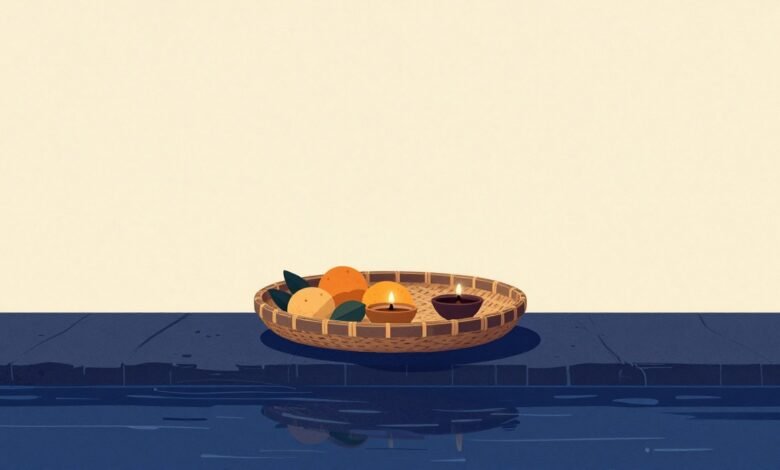
On the loudest festival of the eastern plains, the hardest day is the quietest one. Across Bihar, Jharkhand, eastern Uttar Pradesh and the Terai districts of Nepal, Chhath Puja reaches its second day on Saturday, 14 November. The ritual is called Kharna, and it looks almost like an ordinary family meal. It is not.
The four-day Mahaparva began on Friday with Nahay Khay, when devotees bathed at dawn, cleaned the kitchen, and ate a simple meal of rice, dal and bottle gourd cooked without onion or garlic. Saturday’s Kharna is the pivot. A woman — or, increasingly, a man — who has taken the vow eats a single meal before sunset, then begins a fast without food or water that lasts roughly 36 hours, until the next evening’s offering to the setting sun.
What is cooked on Kharna
The menu is fixed and specific. Jaggery rice kheer — gud ki kheer — cooked slowly in milk until it thickens and darkens. Flatbreads made from wheat flour, often roasted on an open flame. Bananas. In some households, a pumpkin or bottle gourd preparation. The food is offered first, then shared with family members who are not fasting, and only then does the vratin eat.
The meal is deliberately sweet and heavy. It is the last food before a fast that will run through an entire day of preparation, a riverbank journey and a sunset ritual. Jaggery rather than refined sugar is what the region had, and it is what the ritual kept.
Chhath has no priest. The person who fasts is the person who performs the ritual.
The Crescent World
The festival without a priest
This is the detail that makes Chhath unusual among major Hindu festivals. There is no intermediary. The vratin — usually a married woman, though the number of male devotees has grown steadily — performs the entire sequence herself. She prepares the offerings, arranges the soop, walks to the water, and makes the arghya. No Brahmin is required, no mantra is prescribed in Sanskrit, and no temple is involved.
That structure has consequences. It means the festival travels well. A family that migrates from Darbhanga to Delhi, or from Patna to Dubai, can carry the whole observance in memory and a few utensils. It means women are the ritual authorities rather than the sponsors of someone else’s authority. And it means the festival’s continuity depends on transmission inside households, not on institutions that can be audited or funded.
The offerings are simple: thekua, the dense wheat-and-jaggery biscuit that keeps for days; bananas; coconuts; sugarcane; and seasonal fruit arranged in a bamboo soop. The soop itself — a shallow winnowing basket — is the festival’s most recognisable object, and in the diaspora it is often the thing people ask relatives to bring.
Why the sun
Chhath is worship of the sun, and specifically of its two appearances: the setting and the rising. On Sunday, 15 November, devotees will stand in water at sunset and offer arghya to a sun that is leaving. On Monday, 16 November, they will return before dawn and offer arghya to a sun that is arriving. Between those two moments they will not eat or drink.
The theological logic is that the sun is the visible source of life, and that a devotee should greet it in both directions — in decline and in return. The ritual is therefore about endurance rather than petition. It asks for the family’s well-being, but it is structured as an act of standing still, in cold water, twice, with nothing in the stomach.
Chhathi Maiya, the deity associated with the festival, is understood as a protector of children. That association explains why the fast is often undertaken after the birth of a child, and why the festival’s most emotional moment is usually the first arghya of a new mother. It also explains why the observance is passed down along the female line with such insistence.
The crowd and the silence
By Sunday evening, every riverbank, pond and artificial tank from Bhagalpur to Bhopal will be full. Temporary ghats will be built in housing societies in Noida and in parks in Surat. In Mumbai, crowds will gather at Juhu and Versova. In Kathmandu, the ghats along the Bagmati will be packed. The festival is simultaneously intimate and enormous.
What visitors notice first is the discipline. Thousands of people standing in water in the dark, holding lamps, with no amplification and no crowd management beyond the crowd itself. The noise comes afterwards — the songs, the reunions, the food being distributed to neighbours who did not fast. The ritual itself is quiet.
That contrast is why Chhath now attracts wider cultural attention, and why its aesthetics have been absorbed into fashion and advertising. The risk is that a festival about a private vow gets flattened into a visual. The new Indian lifestyle conversation celebrates regional ritual without always leaving it alone.
What Kharna actually asks
By Sunday evening, the fast will be more than a day old, and the arghya will be made by people who have not slept properly, have not eaten, and have walked to a river. Whatever else the festival means, it means that. A vow kept in public, by a person who decided to keep it, with no one authorised to keep it for them.
On Monday morning, after the second arghya, the fast breaks with prasad and the ordinary business of the week resumes. The kheer pot is washed. The soop goes back on its shelf. The household waits twelve months to do it again, which is how a tradition outlives the people who practise it.
Illustration generated with AI (Z-Image Turbo, rendered locally) for The Crescent World.