


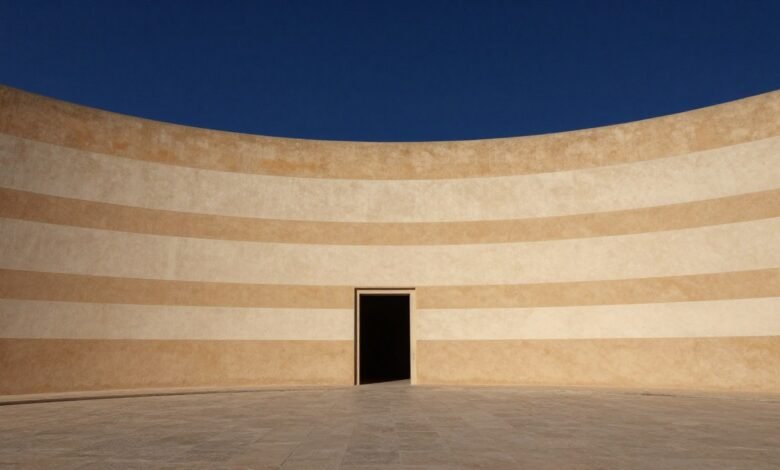
The Anant Anadi Vadnagar Archaeological Experiential Museum has won a Red Dot: Best of the Best 2026 award in the brands and communication design category, for exhibition design. The prize was presented in Berlin on 6 November. Gujarat’s deputy chief minister, Harsh Sanghavi, announced it on social media on Monday, describing it as the first Indian museum to take the award in that category. The museum opened in Vadnagar, in Mehsana district, in January 2025.
A design award is easy to treat as decoration. This one is worth taking seriously, because the building it rewards is an argument about how India should display its own archaeology: not as a room of objects behind glass, but as a structure built into the ground it describes.
The building is the exhibit
Vadnagar is one of the oldest continuously inhabited towns in western India, and the excavation beside the museum runs about 4,000 square metres across, reaching depths of 16 to 18 metres. Rather than flatten the site or cap it, the museum was sunk alongside it. Visitors descend through galleries that follow the stratigraphy, so the sequence of rooms is also a sequence of centuries.
The structure uses seven layers of rammed earth, a material chosen for thermal mass in a district that crosses 40 degrees Celsius in May. Rammed earth is also the oldest building technology on the site; the walls of the museum are made of the same stuff as the walls the museum is about. Spread over roughly 12,500 square metres and costing about ₹298 crore, it is a state project with a national profile.
The design came from Design Factory India, a Noida-based practice, working for the Directorate of Archaeology and Museums in Gandhinagar. That detail matters more than it looks. India has spent a decade commissioning cultural infrastructure and then importing the exhibition design, the lighting and the interpretation. Here the entire chain was domestic.
A museum is not a building that holds the past. It is a machine for making the past legible to someone with forty minutes and a phone.
The Crescent World
Six thousand objects, twenty-five centuries
The collection runs to more than 6,000 artefacts spanning about 2,500 years, displayed across nine galleries. Vadnagar’s importance is that it never emptied. It was a town under the Mauryas, a Buddhist centre, a trading stop on routes running north to Rajasthan and west to the sea, and a settlement that survived every empire that passed through it.
That continuity is the hardest thing to exhibit, because it is an idea rather than an object. A coin, a potsherd and a lamp are easy to display. The fact that they came from the same street, eight centuries apart, is what needs the design. The prize was given for exactly that translation.
Why states are building museums
Gujarat has spent a decade assembling a heritage circuit: Somnath, Dwarka, the Statue of Unity, the Harappan sites of Lothal and Dholavira. Vadnagar adds an archaeological layer that those sites cannot offer, and it does so in a town with a small hotel base, which means the museum has to be a destination rather than a stop on the way to somewhere else.
That is the same bet New Delhi is making at a much larger scale with the Yuge Yugeen Bharat museum in the old North Block, and it is the same bet several other states are making with smaller institutions. Cultural tourism is being treated as infrastructure: something that creates employment, anchors a district and produces a reason for a family to take a train.
The economics are real but slow. A museum costs money every year after it opens, and the revenue from tickets rarely covers conservation, curation and electricity. The return arrives through the district: hotels, transport, restaurants, guides. That return is why the design award is useful. A Best of the Best label is a marketing asset that a state tourism board cannot manufacture.
The harder test
An award is given to a project. An institution is judged over decades. The questions that will decide whether the Vadnagar museum matters are not about rammed earth. Does the collection rotate? Does the interpretation change when the excavation next season produces something new? Is there a curator with a budget, or only a caretaker with a key? Are school groups arriving from Mehsana and Palanpur, or only tourists with cars?
Indian museums have a long history of opening well and ageing badly: the inaugural exhibition stays up for fifteen years, the labels fade, the air conditioning fails and the ticket counter becomes the only member of staff. The design award raises the standard the museum will be held to. It also raises the cost of letting it slip.
What to watch
Visitor numbers through the first full winter season, which is the test of whether Vadnagar can pull a day trip from Ahmedabad. The state’s maintenance budget for the building, because rammed earth needs attention that concrete does not. Whether the excavation continues and feeds the galleries. And whether other Indian museums enter the same awards, which would be the clearest sign that the design capability is a sector rather than a single project.
For now, a museum in a small Gujarat town has won the most recognised design prize in the world, with a building made of mud that sits beside a hole in the ground that took twenty-five centuries to fill. That is a more interesting sentence about Indian soft power than most of what gets said at conferences.
Illustration generated with AI (Z-Image Turbo, rendered locally) for The Crescent World.


