

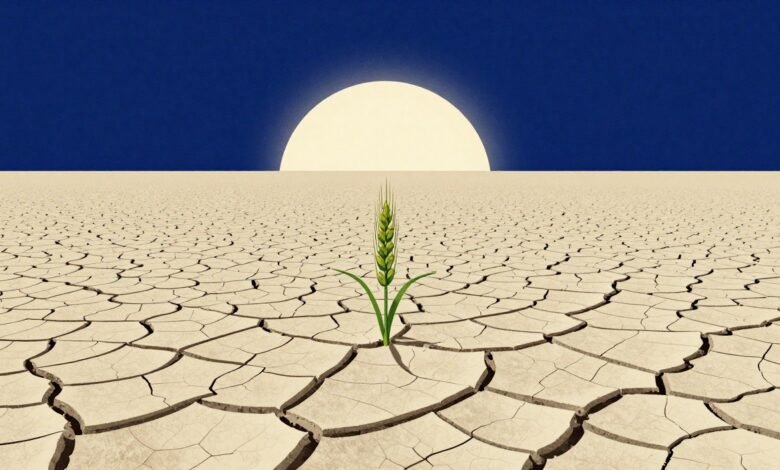
The reservoirs tell the story before the crop data does. As of 12 November, India’s 178 major reservoirs held 63.25% of their combined capacity. On the same date last year they held 89.9%. The normal for mid-November is 78.92%. The deficit is not marginal; it is roughly a quarter of the country’s stored water missing.
The regional split is worse than the national average. Southern reservoirs are at 39.74% against 88.48% a year earlier, with a normal of 74.83%. The northern region is at 55.19% against 85.53%, with a normal of 73.41%. Both regions are running at roughly half their normal level. These are the same reservoirs that supply irrigation canals, hydropower turbines and municipal drinking water.
The sowing numbers arrived second
Rabi sowing as of 6 November covered 108.66 lakh hectares, against 131.26 lakh hectares at the same point last year — a shortfall of 22.59 lakh hectares, or 17.2%. The distribution of that shortfall is what makes it a policy problem rather than a weather story.
Oilseeds fell 23.6% to 42.08 lakh hectares from 55.09 lakh. Within that, rapeseed and mustard dropped 25.4% to 40.31 lakh hectares — and mustard alone accounts for 13.71 lakh hectares of the total gap, roughly 61% of the entire national shortfall. Pulses declined 14.4% to 31.93 lakh hectares, with gram, the largest component, down 21.6% to 21.36 lakh hectares from 27.25 lakh. Wheat, the crop that matters most for food security politics, was down 12% at 19.77 lakh hectares against 22.47 lakh. Coarse cereals fell 17.5% to 8.15 lakh hectares, including a 23.1% drop in maize.
One crop in one belt is carrying most of the damage. Mustard is grown largely in Rajasthan, Madhya Pradesh and Haryana, and Rajasthan received 47% less post-monsoon rain than normal while Madhya Pradesh received 78% less. Maharashtra, the third major deficit state, was 93% below normal. Nationally, rainfall between 1 October and 10 November was 60.3 mm against a normal of 88.4 mm — a 32% shortfall.
Rabi is the irrigated season. That is exactly why the reservoir numbers matter more than the rain.
The Crescent World
Why rabi is supposed to be the safe season
Indian agriculture has an informal division of risk. Kharif, sown with the monsoon, is the gamble. Rabi, sown from October into cooler months and harvested in spring, is the reliable half — because it is largely irrigated. Wheat in Punjab, Haryana and western Uttar Pradesh runs on canal water and tubewells. Gram in Madhya Pradesh runs on residual soil moisture plus supplemental irrigation.
That safety assumption is what the reservoir data attacks. Canal releases for the rabi season are scheduled from stored water. If storage is at 63% instead of 90%, either the releases are cut, the season is shortened, or the groundwater that farmers would otherwise have saved gets pumped instead. All three outcomes reduce the buffer for the next dry year, which is precisely the buffer that carried the system through the last one.
The southern numbers deserve separate attention. At 39.74%, southern storage is less than half its normal level, and the south is where hydropower and the rice belt overlap. A weak rabi there does not just mean less grain; it means higher power costs and more expensive irrigation, in a season when farmers are already absorbing higher input prices.
The inflation channel
This connects directly to a number published days earlier. India’s retail inflation rose to 6.09% in October, with food inflation at 8.94%, driven by onions, garlic and ginger. That was a vegetable shock, and vegetable shocks are usually short. A mustard and pulses shortfall is different: it works through edible oil and dal prices with a lag of months, and it is stickier because it hits processed and packaged food.
India imports more than half its edible oil. A weak domestic mustard crop therefore does two things at once — it raises the import bill and it removes the price cushion that domestic supply normally provides. The same logic applies to pulses, where India has spent years trying to close a structural import gap. The government has already made stock declaration mandatory for pulses, a signal that it expects tightness rather than surplus.
Read alongside the October trade data, where imports hit a record $89.35 billion, the agricultural picture stops being a rural story. Food inflation at 8.94% is already above the RBI’s tolerance band. A poor rabi harvest arriving in March and April would land exactly when the central bank is trying to decide whether price pressure is transient.
What can still change
Rabi sowing runs until late November and, in some areas, into December. A wet spell in the first half of the window can recover a meaningful share of the mustard and gram gap, because both crops can be sown later than wheat without catastrophic yield loss. Wheat is less forgiving: a delayed wheat crop loses yield to heat at the grain-filling stage in March. That is why the 12% wheat shortfall is the number to watch, not the 25% mustard number, even though mustard is larger.
The deeper issue is that India keeps absorbing a bad water year with a good monsoon year. Storage is a stock, and it was rebuilt in 2025 and spent in 2026. Climate-smart farming helps at the margin, but it cannot manufacture water.
Three data releases over the next eight weeks will decide how serious this becomes: the next reservoir bulletin, the rabi sowing update for the week ending 20 November, and the November inflation print. If storage stabilises and sowing catches up, this is a scare. If the mustard belt stays dry through the month, it becomes a supply problem that reaches the kitchen in February — and a political problem well before the harvest.
Illustration generated with AI (Z-Image Turbo, rendered locally) for The Crescent World.