

A New Era in Maritime Deterrence: Decoding India’s Maiden Salvo Launch of the Indigenous Naval Anti-Ship Missile

The geopolitical theater of the 21st century is largely defined by maritime dominance, and India has just made a resounding statement on the global stage. On April 29, 2026, the Defence Research and Development Organisation (DRDO), in seamless coordination with the Indian Navy, achieved a historic milestone: the successful maiden salvo launch of the Naval Anti-Ship Missile – Short Range (NASM-SR). Executed off the coast of Odisha in the Bay of Bengal, this test represents far more than a mere technological demonstration; it is a definitive shift in India’s naval warfare capabilities and a triumph of homegrown engineering.
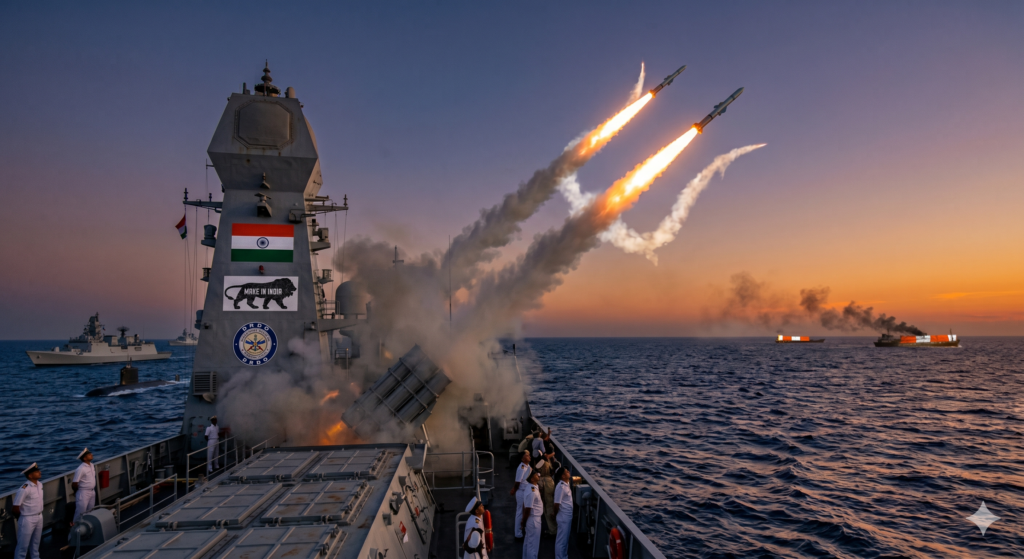
This indigenous naval anti-ship missile system, designed to be deployed from helicopter platforms, completely reimagines the Indian Navy’s aerial strike power. By successfully firing two missiles in rapid succession, India has proven its capability to overwhelm enemy naval defenses in high-stakes combat scenarios. This article delves deeply into the technological anatomy of the NASM-SR, explores the strategic implications of its integration into the armed forces, and analyzes what this landmark achievement means for India’s ongoing quest for defense self-reliance under the Atmanirbhar Bharat initiative.
The Missile: Unveiling the Technology
The transition from conceptual design to a battle-ready, air-launched anti-ship missile is an engineering feat of the highest order. The Naval Anti-Ship Missile – Short Range (NASM-SR) is a testament to the collaborative synergy of India’s premier defense research institutions and domestic manufacturing partners.
Development and the “Indigenous” Aspect
The development of the NASM-SR was spearheaded by the Hyderabad-based Research Centre Imarat (RCI), working in close tandem with other critical DRDO laboratories. These include the Defence Research and Development Laboratory (DRDL) in Hyderabad, the High Energy Materials Research Laboratory (HEMRL) in Pune, and the Terminal Ballistics Research Laboratory (TBRL) in Chandigarh. Furthermore, the missile’s production is currently being driven by designated Development-cum-Production Partners (DcPP), heavily supported by a network of Indian Micro, Small, and Medium Enterprises (MSMEs) and defense start-ups.
What makes the NASM-SR truly “indigenous” is its aggressive departure from imported technologies. For decades, the Indian Navy relied heavily on foreign-origin missiles (such as the British Sea Eagle) for its Sea King helicopters. The NASM-SR changes this paradigm. With an indigenous content currently standing at 65% and targeted to reach 90%, almost all critical sub-systems—from the propulsion and avionics to the highly complex seeker and navigation modules—have been conceptualized, designed, and manufactured within India.
Technical Specifications and Capabilities
The NASM-SR is a formidable addition to India’s arsenal, boasting specifications tailored for modern littoral and open-ocean warfare.
- Range and Weight: The missile weighs approximately 380 kg, making it an ideal payload for rotary-wing aircraft. It possesses an operational range close to 55 km, allowing helicopters to strike enemy vessels from a safe standoff distance, effectively staying out of the range of traditional short-range point-defense systems.
- Warhead and Fusing: To maximize lethal effect, the missile is equipped with a high-explosive warhead triggered by a highly sensitive radio proximity fuse. This fuse ensures the warhead detonates at the optimal distance from the target to maximize blast and fragmentation damage. Crucially, the missile demonstrated a “waterline hit” capability during the test. Striking an enemy ship at or just below the waterline is devastating, as it instantly compromises the vessel’s buoyancy and structural integrity, often leading to rapid flooding and sinking.
- Guidance System: The NASM-SR features an exceptionally sophisticated, multi-layered guidance suite. It utilizes a fibre-optic gyroscope-based Inertial Navigation System (INS) coupled with a radio-altimeter for mid-course sea-skimming flight, allowing it to fly dangerously low over the waves to evade enemy radar. For terminal guidance, it employs an advanced target detection and tracking system (seeker) that DRDO scientists confirm is completely immune to enemy electronic jamming.
- “Man-in-the-Loop” Capability: A game-changing feature proven in previous iterations (such as the February 2025 trials) is the high-bandwidth two-way data link. This allows for a “Man-in-the-Loop” operation. Even after the missile is fired, an operator in the launching helicopter can intervene, assess the targeting data, switch targets in real-time, or abort the strike entirely. This is crucial in congested maritime environments where distinguishing between an enemy combatant and a civilian merchant vessel is critical.
- Propulsion: The missile achieves its sustained flight profile through a solid propulsion booster paired with a long-burn sustainer. This combination ensures rapid acceleration off the launch platform followed by steady, high-speed cruising toward the target.
- Launch Platform: The recent test was conducted from an Indian Navy Sea King 42B helicopter. However, its modular design and manageable weight profile mean it can easily be integrated onto other naval aerial platforms, including the newly inducted MH-60R Romeo multi-role helicopters or the indigenous Advanced Light Helicopter (ALH).
The Tactical Advantage of a Salvo Launch
The most defining characteristic of the April 2026 test was the “salvo launch.” In naval terminology, a salvo launch refers to the simultaneous or near-simultaneous firing of multiple missiles at a single target or a cluster of targets.
Modern warships are equipped with advanced Close-In Weapon Systems (CIWS) and surface-to-air missiles designed to detect and intercept incoming anti-ship missiles. A single missile, no matter how advanced, risks being shot down by a well-defended warship. However, launching two NASM-SR missiles in rapid succession creates a saturation attack. By forcing the enemy ship’s defensive radars and interceptors to track and engage multiple threats arriving at the exact same time, a salvo drastically increases the probability that at least one missile will penetrate the defensive screen and achieve a catastrophic kill.
Strategic Significance and Implications
The successful fielding of the NASM-SR reverberates far beyond the test ranges of Odisha. It recalibrates the strategic calculus in the Indo-Pacific and cements India’s position as a rising naval powerhouse.
Naval Power Enhancement
The Indian Navy’s fundamental doctrine revolves around securing India’s vast coastline, safeguarding exclusive economic zones, and protecting vital Sea Lines of Communication (SLOC). The NASM-SR directly enhances this mission by providing fleet commanders with a highly flexible, rapid-response strike capability. Because helicopters can be deployed rapidly from aircraft carriers, destroyers, or frigates, they can hunt down enemy fast-attack crafts, submarines surfaced for recharging, or larger warships long before they pose a direct threat to the Indian fleet.
Geopolitical Context
The Indo-Pacific is currently the most heavily militarized and geopolitically sensitive maritime region in the world. With an increasingly assertive Chinese People’s Liberation Army Navy (PLAN) expanding its footprint in the Indian Ocean Region, and the persistent security challenges in the Arabian Sea, India requires credible deterrence.
The NASM-SR serves as exactly that. It signals to regional adversaries that Indian naval assets possess organic, highly accurate, and lethal indigenous strike capabilities that cannot be neutered by international arms embargoes or supply-chain disruptions. It ensures that the Indian Navy maintains a tactical edge in anti-access/area-denial (A2/AD) environments.
Self-Reliance (Atmanirbhar Bharat)
For decades, India held the dubious distinction of being one of the world’s largest importers of defense equipment. The successful rollout of the NASM-SR is a shining victory for the Atmanirbhar Bharat (Self-Reliant India) initiative.
By replacing foreign-origin missiles, India saves millions in foreign exchange, but more importantly, it secures its strategic autonomy. Relying on foreign weapons means relying on foreign software, foreign maintenance schedules, and the geopolitical goodwill of the supplier nation. The NASM-SR eliminates this vulnerability. Furthermore, it energizes the domestic military-industrial complex, creating highly skilled jobs and fostering a culture of innovation among Indian MSMEs and tech start-ups involved in the supply chain.
Export Potential
As India transitions from a net importer to a prospective exporter of defense technology, the NASM-SR holds immense potential. Friendly foreign nations, particularly in Southeast Asia, Africa, and the Middle East, are constantly seeking cost-effective, highly reliable anti-ship solutions to protect their coastlines. The successful demonstration of a complex salvo launch makes the NASM-SR an incredibly attractive export commodity, potentially rivaling established Western or Russian systems in the global arms market.
Future Development
The NASM-SR is likely just the vanguard of an entirely new family of indigenous naval strike weapons. With the baseline technology—navigation, jamming-resistant seekers, and data links—now proven, DRDO is well-positioned to scale up the architecture. Future iterations could include Medium-Range (NASM-MR) or Long-Range variants utilizing air-breathing engines (like ramjets or turbofans) for extended reach. Furthermore, adaptations for surface-launch from corvettes or sub-surface launch from submarines are highly plausible next steps.
The Maiden Salvo Launch Event
The meticulous planning and rigorous engineering that birthed the NASM-SR culminated on a momentous day in late April 2026.
The Execution
On April 29, 2026, the skies off the coast of Odisha bore witness to maritime history. The trial was conducted from the Integrated Test Range (ITR) at Chandipur. An Indian Navy Sea King 42B helicopter took to the skies over the Bay of Bengal, carrying two live NASM-SR missiles. In quick succession, the helicopter crew initiated the firing sequence, launching both missiles into the air.
Objectives and Validation
The primary objective of this specific trial was to validate the missile system’s operational readiness in a rapid-fire, high-stress combat scenario. Launching a single missile in a controlled environment is one thing; launching a rapid salvo requires flawless synchronization between the helicopter’s fire control system, the missiles’ avionics, and the physical launch mechanisms to ensure the exhaust of the first missile does not interfere with the guidance or trajectory of the second.
The Ministry of Defence confirmed that every single test objective was meticulously met. The missiles’ flight paths, sea-skimming maneuvers, and terminal dive were continuously tracked by an array of radar, electro-optical tracking systems, and telemetry stations deployed by the ITR. Crucially, the test successfully validated the lethal “waterline hit” capability, proving the missile’s devastating potential against surface combatants.
Official Commendations
The achievement was witnessed by top-tier senior scientists from DRDO, representatives from the user agencies (the Indian Navy and the Indian Air Force), and the production partners.
Raksha Mantri (Defence Minister) Shri Rajnath Singh extended his highest compliments to the DRDO, the armed forces, and the industry partners, officially noting that the development of the NASM-SR substantially augments the capabilities of India’s defense forces. Similarly, Dr. Samir V Kamat, Secretary of the Department of Defence R&D and Chairman of DRDO, celebrated the teams associated with the launch, calling it a tremendously proud moment for the Indian defense research community and a definitive step toward outfitting the Navy with cutting-edge, home-grown weaponry.
Conclusion
The maiden salvo launch of the Naval Anti-Ship Missile – Short Range (NASM-SR) is not an isolated event; it is a vivid reflection of a rising India. It represents a confluence of strategic vision, scientific brilliance, and manufacturing grit. By mastering the complex art of simultaneous missile engagement, sea-skimming navigation, and jam-proof targeting, India has successfully engineered a weapon that dramatically sharpens the tip of the Indian Navy’s spear.
As geopolitical currents continue to shift, the security of the maritime commons will only grow in importance. With the NASM-SR now proving its mettle, India sends a clear message across the oceans: it is not only prepared to defend its maritime interests with unyielding resolve but is now doing so powered by the brilliance of its own indigenous technology. The era of relying on foreign powers to secure Indian waters is rapidly coming to an end, giving way to a fiercely capable, self-reliant Indian Navy ready to face the challenges of tomorrow.
