


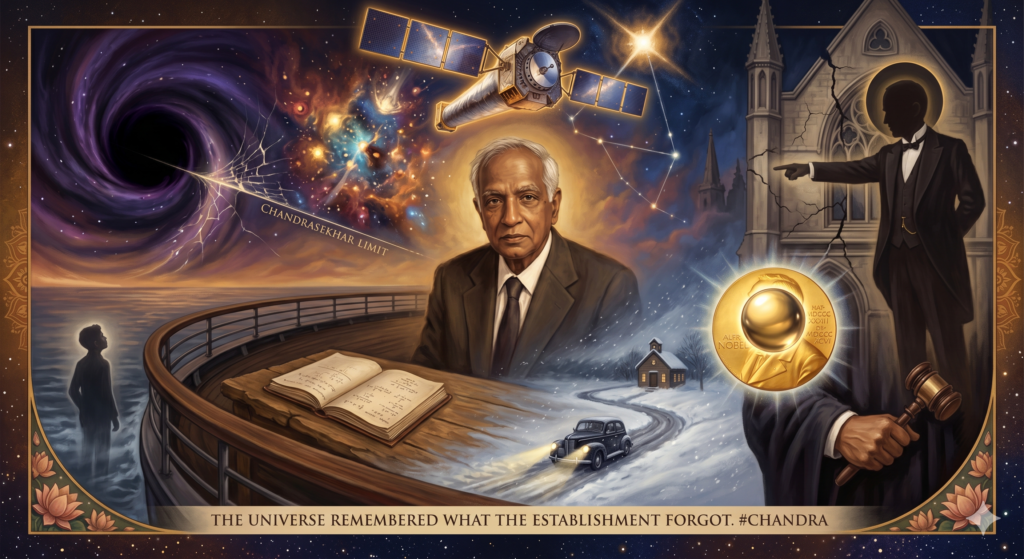
History rarely announces its greatest moments. Sometimes, it does not happen in state-of-the-art laboratories or grand university halls. Sometimes, the deepest secrets of the cosmos are unraveled by a lonely teenager sitting on the deck of a ship, armed with nothing but a notebook, a pen, and an intellect that defied the age he lived in.
His name was Subrahmanyan Chandrasekhar.
In the summer of 1930, he was just 19 years old. A quiet, brilliant boy from Madras, India, he had just boarded a steamship bound for England. He had won a government scholarship to study at the prestigious Cambridge University. As the ship cut through the vast, dark expanse of the Arabian Sea, the boy did not spend his time playing games or mingling with the colonial elite. Instead, he looked up at the night sky, and then down at his notebook. He began to calculate.
By the time that ship docked in Southampton weeks later, this 19-year-old had mathematically worked out a phenomenon so terrifying and bizarre that no one in the history of human science had ever conceived it.
He discovered that stars do not simply fade out peacefully into the dark. He calculated that stars above a certain mass—what we now call the Chandrasekhar Limit—are doomed. When their nuclear fuel runs out, gravity takes over with absolute, merciless tyranny. The star collapses inward, crushing itself with such unfathomable force that the very fabric of space and time tears. Nothing can stop the collapse. Not the laws of physics as they were understood. Not even light could escape its grip.
What the boy from Madras had mathematically proven on that ship was the terrifying reality of Black Holes.
The Mentor and the Trap
Arriving at Cambridge, the young Chandrasekhar threw himself into his work. Over the next four years, he relentlessly refined his calculations. He shared his groundbreaking findings with the scientific titan of the era: Sir Arthur Eddington.
Eddington was not just an astronomer; he was a global icon. He was the man whose eclipse observations in 1919 had proven Albert Einstein’s Theory of Relativity. He was the undisputed king of astrophysics. Eddington took a keen interest in the young Indian prodigy. He checked Chandra’s math, watched his progress, and warmly encouraged him.
In fact, it was Eddington who personally arranged for the young, 24-year-old Chandrasekhar to present his groundbreaking theory to the entire scientific establishment at the Royal Astronomical Society in London in January 1935.
Chandra stepped up to the podium, his heart pounding. He looked out at the sea of brilliant minds and presented his life’s work. He explained how massive stars collapse into an infinitely dense point. He finished his presentation, expecting a rigorous, vibrant debate.
Instead, he walked into a slaughter.
The Brutal Betrayal
Immediately after Chandra spoke, Sir Arthur Eddington took the stage. But Eddington was not there to support his protégé. He was there to bury him.
Using the full weight of his enormous reputation, his commanding presence, and his biting British wit, Eddington publicly ridiculed Chandrasekhar’s theory. He called the idea of a star collapsing into nothingness “absurd” and “stellar buffoonery.” He flatly stated that there must be some undiscovered law of nature that would prevent a star from behaving in such a ridiculous manner.
Eddington didn’t just disagree with the science; he destroyed the boy’s credibility. Why? Because the idea of a black hole offended Eddington’s aesthetic sense of how the universe should behave.
Chandrasekhar sat in the audience, devastated, humiliated, and utterly crushed. The entire scientific establishment, intimidated by Eddington’s god-like status, sided with the elder statesman.
Desperate, Chandra appealed to the president of the International Astronomical Union. The response he received was a polite but firm instruction to step down: Do not engage with Eddington publicly. You cannot win.
An Exile Built on Resilience
Heartbroken but unbroken, Chandra left England. The European scientific community had closed its doors to his truth, so he crossed the Atlantic to the United States, taking a position at the University of Chicago.
There, he made a quiet, monumental choice: he would not spend his life fighting bitter, public battles over his ego. He would simply let the universe prove him right.
He threw himself into a life of profound, monk-like dedication to science and teaching. His commitment was legendary. In the 1940s, he insisted on driving 150 miles every single week from the Yerkes Observatory in Wisconsin to the Chicago campus, often through treacherous blizzards, to teach a class that had only two students.
People thought he was crazy to waste such effort on a class of two. But Chandra saw the spark in them. He taught them with the same rigor and passion as if he were addressing a hall of thousands.
Those two students were Tsung-Dao Lee and Chen-Ning Yang. In 1957, both of them won the Nobel Prize in Physics. Their teacher, the man who had decoded black holes at 19, watched and applauded from the shadows.
The Triumph of Truth
He spent fifty years working quietly. He wrote foundational texts on everything from radiative transfer to the mathematical theory of black holes. He never stopped calculating. He never stopped looking up.
Eventually, the universe spoke up for him. As decades passed, technology caught up with his mathematics. Telescopes grew stronger. Computers grew faster. The scientific community finally looked out into the cosmos and saw exactly what the 19-year-old boy on the boat had told them was there.
Eddington was wrong. The establishment was wrong. The boy from Madras was right.
In 1983, the phone rang in Chicago. It was the Nobel Committee. Exactly 53 years after he sat on a ship bound for England and calculated the death of stars, Subrahmanyan Chandrasekhar was awarded the Nobel Prize in Physics.
When he stood to accept the award, his hair was white, his face lined with the decades of relentless, quiet labor. But his spirit was completely intact.
Immortality
In 1999, NASA launched the most powerful, sophisticated X-ray observatory ever built. Its mission was to stare into the deepest, most violent corners of the universe—to look at supernovas, quasars, and the very black holes that one man had predicted when the world refused to believe him.
They named it the Chandra X-Ray Observatory.
Today, while the name Arthur Eddington is largely confined to history books, the name Chandra floats in the cold vacuum of space, serving as humanity’s eye into the infinite.
Subrahmanyan Chandrasekhar taught us that while authority and ego can suppress the truth for a day, a year, or even half a century, the truth of the universe will always outlast the vanity of men.
Most Indians have never heard his name.
We should say it every day.
