

The Political Letdowns of Three Military Titans: Zhukov, Manekshaw, and MacArthur

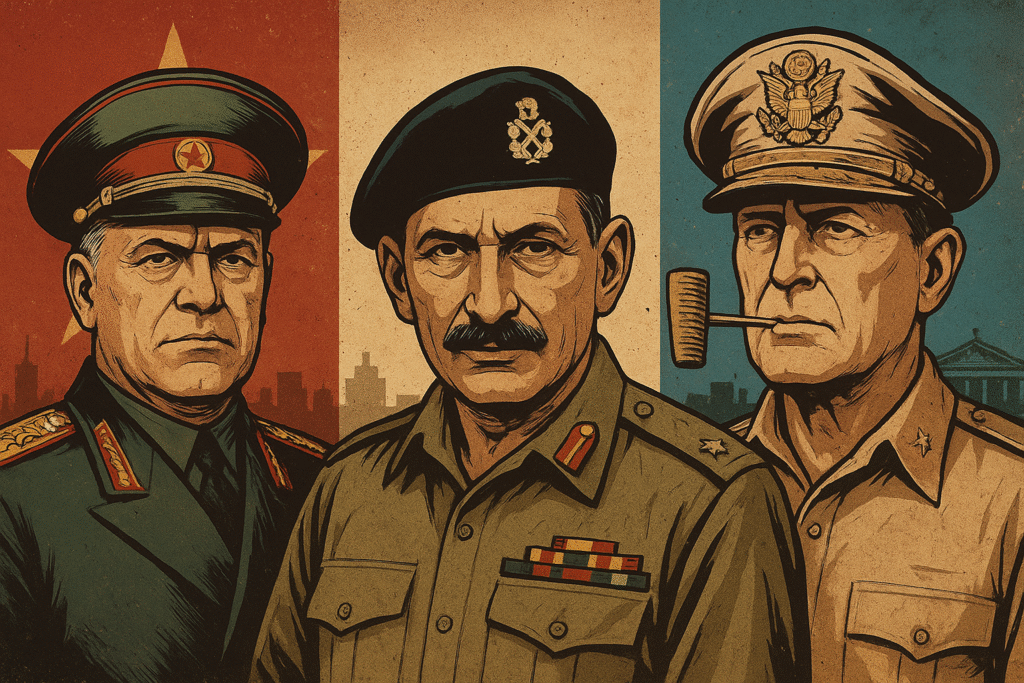
In the annals of military history, few names resonate with the grandeur and strategic brilliance of Georgy Zhukov, Sam Manekshaw, and Douglas MacArthur. Each one a titan in his own right, these generals commanded forces in tumultuous times and shaped the course of wars that defined nations. Yet beyond their battlefield brilliance, each was profoundly affected—and at times let down—by the political leadership and bureaucratic incompetence surrounding them. The disconnect and failures at the political level not only constrained their operational freedom but also cast long shadows on their legacies.
Georgy Zhukov: The Soviet Marshal Shackled by Stalin’s Political Paranoia
Georgy Konstantinovich Zhukov was arguably the Soviet Union’s most brilliant military commander during World War II. Zhukov’s strategic brilliance ensured the survival and eventual victory of the USSR against Nazi Germany, yet his relationship with the Soviet political leadership—particularly Joseph Stalin—was fraught with tension and mistrust.
Political Leadership: Double-Edged Sword of Stalin’s Control
Zhukov played pivotal roles in key battles such as the defense of Moscow (1941), the Siege of Leningrad, the Battle of Stalingrad, and the decisive Battle of Berlin in 1945. Despite these successes, Stalin’s political paranoia meant Zhukov was both indispensable and suspect. Stalin’s preference for absolute control led to frequent interference in military operations, limiting Zhukov’s freedom to maneuver based on his military judgment.
More importantly, Zhukov was frequently sidelined and shifted from critical commands due to Stalin’s fear of his popularity. After the war, instead of being lauded with political favor, Zhukov was demoted and sent to less influential military positions. The postwar political leadership saw him as a threat rather than a hero. This internal political betrayal diminished his role and demoralized the military establishment he had led to victory.
Incompetent Subordinates and Conflicting Bureaucracies
Stalin’s regime was notorious for placing political commissars alongside military commanders, often disrupting coherent command structures. Zhukov had to operate in tandem with these political agents whose primary loyalty lay with the party rather than efficient military strategy. This environment created internal conflicts, slowed decision-making, and diluted the chain of command—factors detrimental to optimal wartime performance.
Thus, despite Zhukov’s tactical and operational genius, the political leadership’s distrust and the overreach of politically appointed subordinates curtailed his effectiveness and recognition. His career trajectory was a testament to the limits political interference imposed on even the most capable of military minds.
Sam Manekshaw: India’s Field Marshal Undermined by Political Myopia
Samtoshaw Manekshaw, one of India’s greatest military leaders, commanded with an impeccable blend of strategy, courage, and charisma. His leadership during the 1971 Indo-Pakistan War was instrumental in the birth of Bangladesh. Yet, his relationship with India’s political leadership was marked by significant challenges that could have jeopardized national security.
Political Leadership: Distrust and Delayed Decisions
Manekshaw’s tenure coincided with a volatile political climate dominated by Prime Minister Indira Gandhi’s government. The political leadership, often marked by indecisiveness and bureaucratic delays, hesitated initially to support military action against Pakistan due to fears of international repercussions and concerns over internal politics.
Despite Manekshaw’s clear strategic vision and readiness to launch preemptive military operations, political leaders delayed decisions and intervened with micromanagement. This delay threatened to diminish the element of surprise, critical in warfare, and caused periods of uncertainty among the armed forces. Manekshaw famously stood his ground, insisting that a war should only be fought when India’s forces were fully prepared—highlighting the tension between military readiness and political will.
Political Subordinates: Bureaucratic Inefficiencies and Military-Civil Disconnect
The Indian military’s operational capabilities under Manekshaw were at times hindered by political subordinates and bureaucrats who lacked military understanding. This disconnect slowed logistics, procurement, and coordination necessary for rapid and effective military engagement. Manekshaw had to maneuver carefully, asserting military imperatives while diplomatically managing political expectations and interference.
His pointed criticism of bureaucratic bungling, combined with his ability to maintain the morale of his troops against political uncertainty, marked his leadership. Still, the overarching political and bureaucratic incompetence posed recurrent obstacles to his strategic command. The Indian military’s ultimate success in 1971 was as much a personal triumph for Manekshaw as it was a reflection of overcoming these political handicaps.
Douglas MacArthur: The American General Stalled by Political Hubris and Rivalries
General Douglas MacArthur was one of America’s most prominent and controversial military leaders in the 20th century. Known for his role in World War II and the Korean War, MacArthur was a commanding figure with grand visions for military and political strategy. However, he famously clashed with political leaders, culminating in his relief from command during the Korean War—a stark example of military-political tensions.
Political Leadership: Clash with Truman and Cold War Constraints
MacArthur’s vision extended beyond the battlefield. He advocated for a more aggressive approach in Korea, including potential incursions into China. This ran counter to the political leadership’s strategy of limited war, aimed at avoiding a broader conflict with the Soviet Union and China during the Cold War.
President Harry S. Truman and his advisers viewed MacArthur’s insubordination and public criticisms of civil leadership as dangerous to civilian control of the military. Despite MacArthur’s battlefield successes, his political miscalculations and arrogance led to a dramatic rupture with the administration. Ultimately, Truman’s decision to relieve MacArthur of his command in 1951 showcased the primacy of political control over military ambitions, a move that both damaged MacArthur’s public image and highlighted political leadership’s distrust of independent military power.
Incompetent Political Subordinates and Civil-Military Frictions
MacArthur faced numerous instances of bureaucratic mishandling and conflicting orders from political subordinates who lacked military experience. The intricate interplay of the Joint Chiefs, State Department officials, and war planners often led to contradictory directives and confusion. This institutional fragmentation within the American political-military apparatus complicated MacArthur’s efforts to execute his strategic vision fully.
Moreover, his high-command style and perceived hubris alienated not only Washington but also allied leaders and some of his subordinates. His overreach magnified political insecurities, leading to a constriction of his operational scope and eventual political sidelining. MacArthur’s fall is a cautionary tale of how political leadership and military command can clash, with profound consequences for both.
Comparative Analysis: Political Failures and Military Leadership
| Aspect | Georgy Zhukov | Sam Manekshaw | Douglas MacArthur |
|---|---|---|---|
| Political Leadership | Stalin’s paranoia and control | Indira Gandhi’s indecision | Truman’s containment policy vs. MacArthur’s aggression |
| Political Subordinates | Political commissars’ interference | Bureaucratic inefficiency | Conflicting civilian agencies |
| Impact on Military Freedom | Frequent sidelining and demotion | Delayed war decisions, micromanagement | Relief from command for insubordination |
| Legacy Effect | Undervalued despite victories | Heroic but challenged by politics | Controversial figure, political fall from grace |
Sum-up
The careers of Georgy Zhukov, Sam Manekshaw, and Douglas MacArthur reveal a common theme: even the most skilled and courageous military leaders can be profoundly affected by political leadership failures and incompetent political subordinates. Each man faced distinct political cultures and challenges, yet all were constrained by political mistrust, indecisiveness, and bureaucratic inefficiencies.
Zhukov’s brilliance could not exempt him from Stalin’s political purges; Manekshaw’s strategic foresight was hampered by India’s hesitant political decisions and bureaucracy; MacArthur’s grand vision succumbed to the demands of Cold War political control and civil supremacy. Their experiences illustrate the critical importance of cohesive civil-military relationships, political acumen, and the dangers when military leadership is undermined by politics.
