


Every Indian government since 1947 has operated in a demanding neighbourhood, but the current formulation of the Indian government foreign policy — multi-aligned, economically expansive and openly self-interested — marks a real departure from both the Cold War-era non-alignment and the cautious pragmatism of the 1990s and 2000s. This article maps the main strategies of India’s foreign policy and examines their implications for the region and for the wider world order.
The strategy stack: five doctrines that drive Indian government foreign policy
- Neighbourhood First. Geographical reality shapes policy: Bangladesh, Sri Lanka, Nepal, Bhutan, Myanmar, the Maldives and Pakistan dominate for security, water, trade and connectivity. In practice this has meant fast financial support for neighbours in distress (from Sri Lanka’s 2022 crisis to Maldives budget support since 2024) alongside harder responses when stability is threatened.
- Act East. India has upgraded its eastern engagement from a decade-long “Look East” outreach into operational defence and connectivity partners: closer coordination with ASEAN centrality, an ambitious India-Japan partnership, bilateral defence pacts with the Philippines and Vietnam, and maritime deployments east of the Malacca Strait.
- SAGAR and MAHASAGAR. The Indian Ocean vision first spelled out in 2015 under the acronym SAGAR (Security and Growth for All in the Region) was expanded in March 2025 to MAHASAGAR, reflecting a bigger ambition: the entire Indo-Pacific as India’s strategic operating space.
- Multi-alignment. Acting simultaneously inside BRICS with China and Russia, inside the Quad with the United States, Japan and Australia, and inside the expanding Gulf partnership, India preserves strategic autonomy while extracting benefits from every camp.
- Global South leadership. The 2023 G20 presidency, the African Union’s permanent G20 admission, and the “Voice of the Global South” summit series turned Delhi into the default convener for developing economies — an ascending position from which to press claims on IMF quota reform and a permanent UN Security Council seat.
Trade diplomacy: the new weapon of choice
The most consequential change in Indian foreign policy over the past five years is the pace and size of its trade agreements. After staying out of major regional trade architecture for most of the 2010s, India has since concluded the UAE Comprehensive Economic Partnership Agreement (2022), the Australia ECTA (2022), the Trade and Economic Partnership Agreement with the four-country EFTA bloc (2024, carrying a reported $100 billion investment commitment) and the India-UK trade deal (2025). Talks with the EU continue. Each agreement multiplies suppliers and buyers for Indian industry and gives Delhi quiet leverage in wider geopolitical disputes — trade diversification is the structure behind India’s ability to absorb tariff shocks without changing course.
Strategic autonomy in practice
India’s refusal to take sides in the Russia-Ukraine war is the textbook example. Delhi’s procurement choices tell the story plainly: the S-400 air defense systems from Russia were bought even at the risk of American CAATSA sanctions; discounted Russian crude, which barely registered before 2022, was taken only as long as the discount lasted — and quietly rebalanced once the price advantage narrowed; at the same time, India signed major defense co-production understandings with the United States, including jet-engine manufacturing for Indian fighters. This is not incoherence; it is deliberate diversification — sourcing different systems from different providers, so that no single partner can choke India’s security.
“Vasudhaiva Kutumbakam — the world is one family.”
Motto of India’s 2023 G20 presidency, invoked by Prime Minister Narendra Modi throughout the summit year
Case study: citizen protection as foreign policy
Indian strategy is also visible in trouble-zone crisis management. Operation Ganga in 2023 brought home roughly 22,500 Indians and dozens of foreign nationals stranded by the Ukraine war; Operation Kaveri in 2024 evacuated thousands from Sudan under fire; and routine Gulf operations protect the tens of thousands sailing between Indian ports and the Emirates each year. Each rescue converts the Indian state’s credibility into political capital at home and influence abroad — a formula India’s 35-million-strong diaspora pays close attention to.
Implications for the region and the world
- For South Asia: India’s development-partnership approach — credit lines worth more than $12 billion across dozens of countries, plus grant assistance — competes directly with Chinese Belt and Road offers, and increasingly wins where projects are modular and transparent.
- For the US-China contest: India is the swing power of the Indo-Pacific. Washington treats Delhi as the long-term hedge; Beijing works to keep Delhi inside BRICS and away from any formal US alliance. Indian policy deliberately keeps both bets alive.
- For global governance: Expect continued pressure on UN, IMF and World Bank reform, with BRICS family instruments (the New Development Bank and the 2026-era initiatives) used as demonstrations that alternatives exist when reform stalls.
What to watch
The next stress test for Indian government foreign policy will be the 2026 BRICS chairmanship, held under a US tariff environment that has punished BRICS membership rhetorically. How Delhi balances its chairmanship duties, its partnership with Washington and its border diplomacy with Beijing — against the backdrop of the India-China relations reset begun in October 2024 — will reveal whether the multi-alignment model can withstand great-power pressure from more than one direction at once.
Over to you. Which pillar of Indian foreign policy do you think matters most over the next five years — trade agreements, strategic autonomy or Global South leadership? Add your assessment in the comments, and share this piece with anyone following India’s global rise.
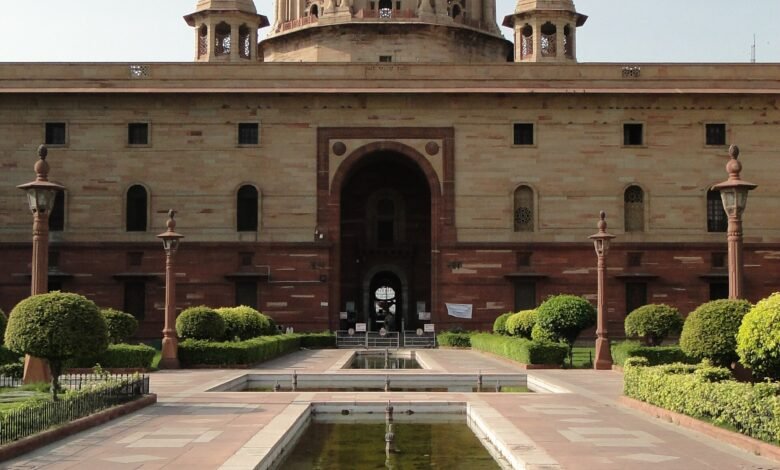
Lead image: South (and North) Block, New Delhi — home of the Ministry of External Affairs. Photo: Ankur Panchbudhe, via Wikimedia Commons (CC BY 2.0).


