

Can India Feed the Future? How Modi’s Digital Agriculture Push Is Becoming a BRICS Model

The hardest test of any digital revolution is not cities with fibre networks and young engineers — it is a farmer holding a basic smartphone in a village where data is thin and intermediaries thicken every transaction. That is why the numbers India reported in October 2026 deserve global attention: more than 11 crore Farmer IDs created under the ₹2,817 crore Digital Agriculture Mission, crossing its full 2027 target five months early. What began as an identity exercise is maturing into a model for how the Global South can digitise agriculture from the soil up — and BRICS members are watching closely.
What AgriStack actually is
Approved in September 2024, the Digital Agriculture Mission built its platform — AgriStack — like India’s other digital public infrastructures: as a foundation, not an app. Three federated registries sit at its core, all maintained by the states: a Farmers’ Registry that issues a digitally verifiable Farmer ID anchored in Aadhaar; geo-referenced village maps; and a crop-sown registry filled in season after season through the Digital Crop Survey conducted plot-by-plot on mobile devices. In Rabi 2025–26 the survey covered 648 districts and more than 31.3 crore plots. A parallel system — the Digital General Crop Estimation Survey — has digitised crop-cutting experiments across 43,105 villages, turning crop-yield estimation from a statistical guess into an evidence chain.
Above the registries sit the analytical layers: the Krishi Decision Support System fusing satellite imagery with weather, soil and crop data on a national GIS platform, and a nationwide soil-resource mapping project that has already covered 52.38 million hectares at village-level resolution. Together they give a government the one thing agricultural administration never had — a single, current picture of who farms what, where, and how it is doing.
You cannot deliver precision agriculture without identity. India solved identity first — everything else now compounds.
The Crescent World
Case studies: the money moving in real time
- Maharashtra’s disaster engine. When Kharif 2025 crop losses hit, the state pushed over ₹14,000 crore to 89 lakh farmers through ID-verified direct benefit transfer — relief that previously took months of field verification.
- Credit in half an hour. Farmer IDs tied to verified land and crop records now let banks sanction Kisan Credit Card loans within thirty minutes, collapsing weeks of paperwork.
- MSP procurement. Chhattisgarh institutionalised Farmer IDs for paddy procurement, covering over 32 lakh farmers in a single season with sharper verification and faster payments.
- AI advisory in the local language. Maharashtra’s MahaVistar pushes weather, pest, market and crop-management guidance to farmers’ phones in Marathi — a preview of what AgriStack-linked AI consultancies will look like across the Global South.
The BRICS and Global South dimension
India did not design this in isolation. The 2026 BRICS chairship placed agroecology, fintech and science-and-technology cooperation on the official agenda, and India has spent two years exporting its digital public infrastructure doctrine to the Global South — starting with payments and identity, and now extending to agriculture. The New Delhi Declaration endorses data-driven, innovation-led approaches to food security, and the AI in Agriculture casebook released at February’s AI Impact Summit — developed with Maharashtra and supported by the World Bank — is being circulated as a template among developing countries. The logic is straightforward: most of the world’s farms are smallholder plots in precisely the countries joining BRICS and its partner network, and none of them can afford Silicon Valley’s per-farm economics. A public-registry model they can copy free is the only viable path.
The stakes could not be higher. Climate volatility is reshaping sowing calendars across the tropics; food inflation has destabilised governments from Cairo to Colombo; and the population of the Global South is still growing into a mid-century food demand peak. Production estimation, crop insurance targeting, credit access and climate advisory are not luxuries in that world — they are the difference between a managed transition and repeated crises.
The frictions India is still solving
- Tenants and the landless. Because registries rest on land records, tenant farmers and sharecroppers — a vast slice of actual cultivation — risk missing benefits; officials acknowledge the gap and states are improvising outreach through farmer producer organisations and Common Service Centres.
- Adivasi and forest-rights farmers. Forest Rights Act holders need special registration pathways — Maharashtra alone has begun with tens of thousands; the long tail remains.
- Connectivity and consent. Rural internet is better and still patchy in spots, and the privacy framework under the Digital Personal Data Protection Act is young — farmer consent architecture will decide trust.
There is also the deeper question of intent: data infrastructure built for welfare can drift toward surveillance if consent governance slackens. India wrote farmer consent and data control into AgriStack’s operating rules early — international observers will be watching whether practice keeps pace.
Still, the direction holds. Eleven crore digital farm identities, real-time crop data at national scale, minutes-not-months credit, and AI advice in village languages add up to a demonstrable fact: the country whose digital bread-earners were call centres is now writing the operating manual for digitising one of the hardest sectors on earth — and offering it, free, to everyone facing the same problem.
Tell us. Can other Global South countries replicate the AgriStack model — or does India’s scale make it a one-off? Share your view in the comments, and send this to anyone working on food security.
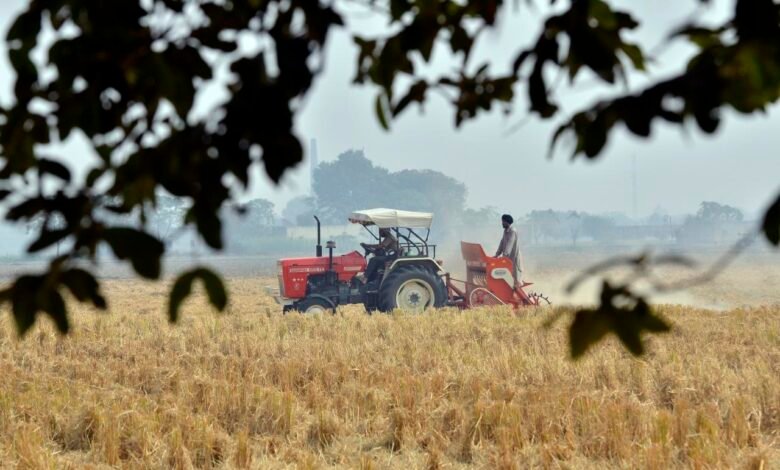
Featured image: tractorised sowing of a wheat crop in Punjab, India. Photo: CIAT (CC BY-SA 2.0), via Wikimedia Commons.


