

The Rise of Bharat Lifestyle: Why the Global South Is Looking to India for Inspiration

A turmeric latte in London. Sunrise yoga in a New York gym. Ashwagandha capsules on a Berlin pharmacy shelf. Henna at Coachella, Kolhapuri-inspired sandals on a Milan runway. Two decades ago, much of this vocabulary needed translating outside South Asia. Today it is simply global lifestyle language — and behind it sits a shift with real cultural weight: the Global South is no longer waiting for the West to define what a good life looks like. Increasingly, it is looking to India for inspiration.
Wellness: the billion-practitioner export
Start with the numbers, because they make the point without any slogans. An estimated 300 million people practise yoga worldwide — had it been a faith, it would rank among the five largest religions on earth. The International Day of Yoga, proposed by India, was co-sponsored by a record 177 countries at the UN. India’s health and wellness market is projected to grow from $156 billion in 2024 to over $256 billion by 2033, with wellness tourism alone expected to cross $57 billion. Exports of AYUSH and herbal products climbed from $540 million in 2020–21 to $689 million in 2024–25, New Delhi has signed traditional-medicine agreements with 25 countries, and Patanjali — whatever its controversies — now ships Indian wellness to roughly 30 markets. The domestic yoga economy, along with the apparel, retreats, teacher-training and corporate programmes Modi brands a “new yoga economy”, is only beginning to commercialise.
The discovery of 2026 is that this is also a broadcast. Wellness supply chains built by Indian founders now run through Africa, Southeast Asia and Latin America — markets that look to a precedent from within the South rather than through a Western filter. Yoga travelling from India to the Global South as an everyday, park-and-school practice rather than a luxury studio subscription is exactly the accessible template many developing economies want to copy.
For most of modern history, lifestyle was imported. The new Indian consumer — and the new Indian brand — inverted the flow.
The Crescent World
Beauty, fashion and the credit turn
The beauty story carries the economics. India is the world’s seventh-largest beauty market — about $27 billion by 2029 on Euromonitor’s trajectory — and 78 per cent of beauty executives surveyed by McKinsey named India the market with the largest growth potential. Ayurveda-led brands are doing the cultural export work: Forest Essentials and its science-backed Ayurveda built credibility at home and abroad, and global conglomerates now court Indian labels for exactly that crossover. Fashion has followed the same arc from appropriation to acknowledgement. Ananya Panday became Chanel’s first Indian global ambassador; Shah Rukh Khan made his Met Gala debut; Diljit Dosanjh turned Indian silhouettes into global red-carpet language. And when a European fashion house released Kolhapuri-style sandals without crediting the tradition that produced them, the pushback that followed — loud, global, and led from the South — settled the new norm: inspiration is fine, credit is mandatory.
That norm is the sharpest expression of what is actually changing. Gen Z’s viral debate about who profits from yoga mirrors the point: the Global South, led by a generation fluent in the same internet as the West, is no longer content to supply aesthetics while someone else owns the brand. India’s demographic weight — the world’s largest young consumer base, hundreds of millions digitally native — gives the claim market teeth.
Why it is the Global South’s template
- The local-first consumer. Surveys of Indian consumption now show local brands filling 66 per cent of shopping baskets — chosen on merit: humidity-proof beauty, modest activewear, regional food. That is a lifestyle doctrine every developing market can adopt without imitating the West.
- Modern without Western. India demonstrates what analysts call non-Western modernity — global design fluency with rooted identity, multi-generational living with digital-first habits. Plenty of Nairobi, Jakarta and Dubai consumers find that more relevant than Copenhagen minimalism.
- Cultural infrastructure. UNESCO recognition for Kumbh Mela and Durga Puja, AYUSH teaching partnerships abroad, and diaspora networks of 35 million people — India underwrites cultural capacity that the South can build on.
The honest frictions
An objective picture needs friction. Standardisation and scientific validation of Ayurvedic medicines remain uneven — without them, India risks ceding the natural-wellness market to better-branded outsiders. Domestic quality inconsistency lets sceptics dismiss genuine traditions. The commercialisation of yoga away from its roots draws genuine criticism about what gets lost in translation, and the answer — credible institutions, trained teachers, honest lineage — is organisational work, not vibes. And cultural prestige only transfers if hospitality and services deliver a world-class experience when the Global South’s new middle classes travel to India to see the source.
Still, the direction of 2026 is unmistakable. Soft power used to be measured in embassies and aid packages. Increasingly it will be measured in what the world wears to work, drinks at sunrise, and calls its morning routine. On that scoreboard, India is not chasing the Global South’s imagination — it is housing it.
Tell us below. What Indian lifestyle export has changed your daily routine — yoga, ayurveda, fashion, food? Make your case in the comments, and share this piece with a friend who caught the wellness wave.
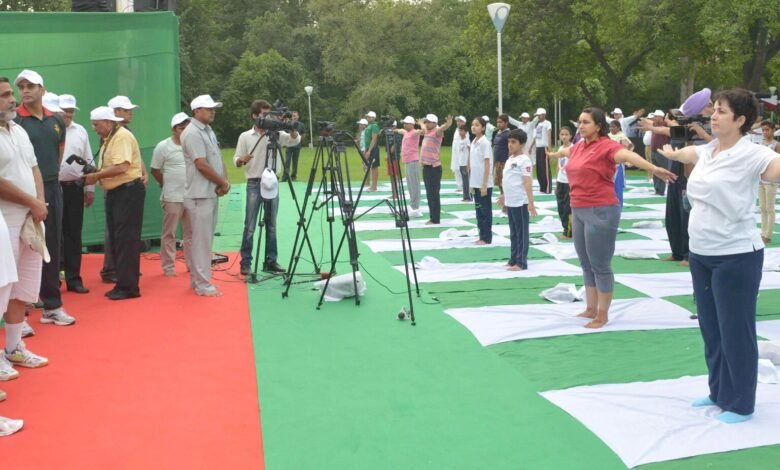
Featured image: a mass yoga event at Rashtrapati Bhavan, New Delhi, marking the International Day of Yoga. Photo: President’s Secretariat, Government of India (GODL-India), via Wikimedia Commons.


