

Ahmedabad’s Karai Sports Hub Gets a 50,000-Seat Stadium as CWG 2030 Preparations Accelerate

Ahmedabad’s bid to host the 2030 Commonwealth Games moved from blueprint to construction site this week, with officials confirming that a 50,000-seat athletics stadium, an international-standard indoor shooting centre and a multi-discipline indoor arena will anchor the new sports hub at Karai. The complex — spread across 143 acres of the Gujarat Police Academy campus and budgeted at roughly ₹1,450 crore — is the second major venue cluster announced for the centenary Games, and the clearest sign yet that the city intends to build for permanence rather than for a three-week event.
What is actually planned at Karai
- A 50,000-seat athletics stadium, the largest facility in the master plan, designed to serve both as the CWG athletics venue and as a permanent national centre for track-and-field events after 2030.
- An indoor shooting centre with 10-metre, 25-metre and 50-metre ranges to international specification — a discipline where India has world-class talent but chronically inadequate home ranges.
- A multi-discipline indoor arena able to host several sports and major events, allowing the hub to run competitions and training simultaneously without schedule conflicts.
- Zoned planning — separate areas for competition, training, administration, education, residential facilities and event operations — an integrated layout international federations increasingly expect from host cities.
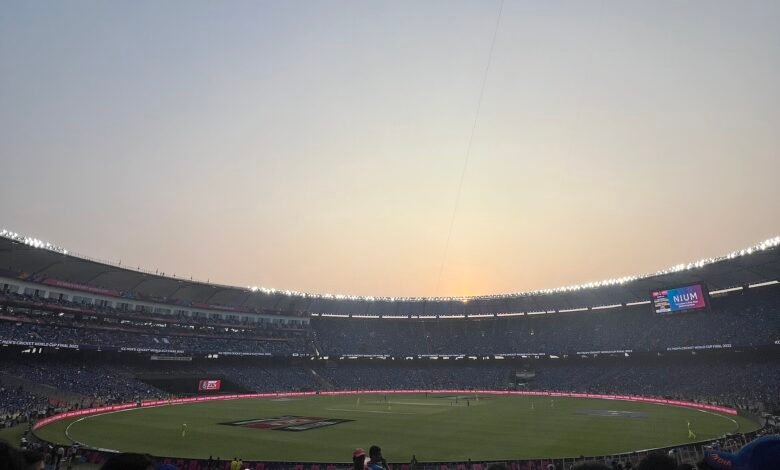
Karai joins the SVP Sports Enclave around the 132,000-seat Narendra Modi Stadium — a 335-acre complex adding an aquatics centre, tennis centre and indoor arena at an estimated ₹5,000–6,000 crore — as the twin pillars of the Ahmedabad 2030 programme. The Games announcement puts the total committed venue investment above ₹7,000 crore before transport, accommodation and city-upgrade spending are counted.
Hosting is easy money. Legacy venues that stay busy in 2031 — that is what separates a Games from a festival.
The Crescent World
Why Karai matters beyond one Games
India’s problem in sport has never been talent or enthusiasm; it has been assets. When a promising shooter or wrestler reaches national level, the pathway often runs through facilities built for events decades ago. Karai’s design answers that directly: ranges, tracks and arenas notable not for their scale alone but for their stated afterlife — year-round training, coaching education and domestic competition on the same campus that hosts the Commonwealth programme.
The strategic backdrop is an ₹36,441 crore Khelo India expansion approved in July 2026, the largest sports allocation in Indian history, plus the 2027 World Police and Fire Games — 10,000-plus competitors from 72 countries — which will function as the first full organisational rehearsal before 2030. Officials involved with the Karai master plan describe the sequencing deliberately: rehearse at a smaller multi-sport event, test transport and accreditation systems, fix weaknesses, then face the world’s broadcasters in 2030 with the reputational memory of 2010 still vivid.
What to watch next
- Construction timelines. Athletics stadiums of this scale typically need three to four years from groundbreaking; a 2030 deadline leaves little slack, and schedule disclosure will be the first honest test.
- Operator appointments. Whether international federations or domestic sports authorities run each venue after 2030 decides how “legacy” the legacy is.
- The indigenous-sports question. With kabaddi, kho kho, mallakhamb and yogasana under consideration for the 2030 programme, indoor arenas like Karai’s are where that conversation becomes architecture.
The announcement also reshapes the optics of the 2036 Olympic conversation. Every venue India builds to Commonwealth specification doubles as evidence in the file the International Olympic Committee keeps on candidate cities: not only capacity, but delivery discipline, athlete-centred design and a post-Games operating plan. The Karai master plan’s explicit zoning — education and residential facilities beside competition arenas — reads directly from that checklist. Ahmedabad’s bid team knows the 2030 Games are, in effect, the audition tape for a later Summer Games decision, and the speed of this week’s announcements suggests they intend every frame of the tape to show shovel-ready competence.
The honest frictions
- Delivery credibility. The 2010 Delhi Games left a heavy memory; every deadline missed or budget revised will be measured against it.
- Utilisation risk. Large indoor and athletics venues across the world struggle for post-Games events; without a strong domestic calendar, white elephants are built one promise at a time.
- Distribution politics. Ahmedabad’s gain must be balanced with sport infrastructure in the rest of the country, or the “superpower” claim narrows to one city’s benefit.
The measurement that will matter is simple and public: when a young athlete from a district school ticks a box that says “khel”, how close is the nearest world-class facility — and does it cost her anything? Karai is a bet that the answer improves nationwide before the opening ceremony does.
What are the biggest challenges facing the Global South when it comes to sport infrastructure investment — and does India’s approach offer a template?
Your turn. Is Ahmedabad building a genuine sporting legacy or the Games’ next set of expensive unused stadiums? Put your verdict in the comments.
Read more from the article series: If you have not followed the story so far, read our full analysis of India’s sporting decade in Beyond Cricket: How Modi’s Sporting Vision Is Turning India into the Global South’s Next Sports Superpower.
Featured image: the ICC Men’s Cricket World Cup 2023 final at the Narendra Modi Stadium, Ahmedabad. Photo: Ishi6181 (CC0), via Wikimedia Commons.


