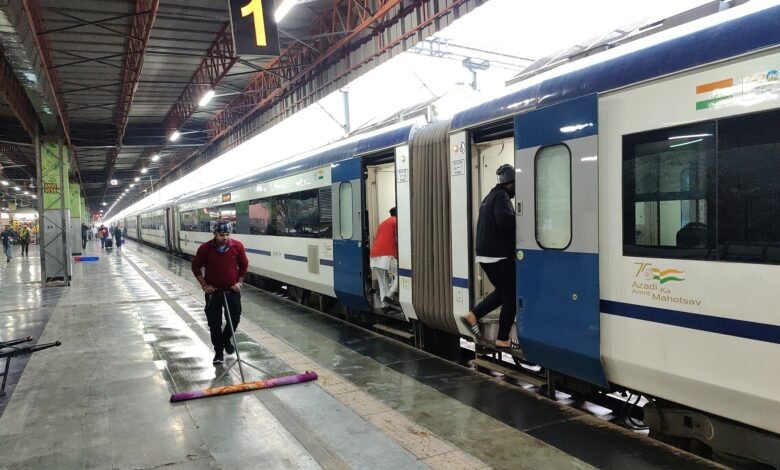
Prime Minister Narendra Modi and Nepal Prime Minister Balendra Shah are set to flag off the Ayodhya-Janakpur Express on 23 November, according to the Indian Express and the Times of India. The service will connect two of the most important destinations in the Ramayana tradition, covering about 604 km across Uttar Pradesh, Bihar and Nepal.
It is tempting to file this under religious tourism and move on. That would miss the point. A cross-border train with a joint flag-off is a small but checkable piece of neighbourhood diplomacy: something both governments can point to, and something passengers will test every week.
The Route and the Details
The Indian Express reports 10 intermediate stops: Jaynagar, Madhubani, Shisho, Sitamarhi, Raxaul, Narkatiaganj, Gorakhpur, Basti, Mankapur and Ayodhya Dham. The train will run once a week, departing Janakpur Dham on Saturdays and Ayodhya Cantt on Mondays. The inaugural run is from Ayodhya Dham.
The Times of India reports that the service will use conventional LHB coaches with air-conditioned and sleeper accommodation. Some social-media posts have called it a Vande Bharat service; the reported official details do not support that label. Precision matters here, because the train’s value lies in what it actually delivers, not in the adjective attached to it.
Why Pilgrimage Infrastructure Is Real Infrastructure
The Ministry of Railways says improved connectivity between Ayodhya and Janakpur Dham will make travel easier for pilgrims and tourists, strengthen people-to-people ties and support local hotels, shops, transport operators and tourism businesses. That is not ceremonial language. Pilgrimage travel is one of India’s most durable forms of domestic and cross-border movement, and it spreads spending well beyond the terminal station.
A weekly train can fill hotel rooms in Janakpur, add footfall in Gorakhpur and Basti, and give families in border districts a simpler way to visit relatives. It also plugs into a larger Indian push to treat cultural and religious routes as tourism infrastructure. Our coverage of the BRICS tourism corridor showed how faith, heritage and connectivity are being bundled into foreign policy. Ayodhya-Janakpur is the neighbourhood-scale version.
The Border Economy Angle
Raxaul and Jaynagar are not incidental stops. They are among the most important India-Nepal border points for trade and movement. A passenger train does not move freight, and it does not replace customs infrastructure. But regular passenger mobility makes border economies easier to manage: traders travel, families reconnect, service providers see predictable demand, and officials get a routine rather than a one-off event.
The more ambitious version of this story would involve more frequent services, seamless immigration processes, coordinated timetables and onwards connectivity on the Nepal side. One weekly train cannot do that. It can, however, create the habit of thinking about India-Nepal connectivity as a network rather than a set of announcement-day photographs.
The train is not a trade deal. It is the kind of small, working connection that makes trade deals easier to imagine.
Diplomacy in Checkable Steps
Joint infrastructure is useful precisely because it is hard to fake. A flag-off can be staged, but a train has to run, arrive, return and be booked by passengers. If it works, both governments gain a tangible achievement. If it is irregular or inconvenient, the symbolism fades quickly.
That makes the Ayodhya-Janakpur Express more interesting than a typical summit deliverable. India and Nepal have a long history of cultural and social ties, but diplomacy often stalls at the level of declarations. A weekly service gives the relationship an operational test. It also echoes a broader shift in India’s neighbourhood policy toward visible, small-scale connectivity rather than only large strategic projects.
India has learned that connectivity is also about confidence. When Digi Yatra went abroad on trial, the promise was smoother movement, not grander aircraft. The same principle applies here: the value comes from making an ordinary journey less difficult.
What to Watch
Five practical questions follow the inaugural run. Does the service keep its weekly schedule in the first month? Are booking systems easy for passengers on both sides? How long do border formalities take? Are the intermediate stops actually useful, or are they administrative conveniences? And will Indian Railways and its Nepali counterpart add frequency if demand appears?
The answers will tell us whether this is a durable new route or a ceremonial one. Passenger numbers after three months will be more informative than any speech on 23 November.
What It Means
The Ayodhya-Janakpur Express links two sacred destinations, but its significance is not only spiritual. It is a practical investment in people-to-people contact, border-town livelihoods and India-Nepal trust. It is modest, testable and therefore more useful than a grand declaration that nobody can board.
If it runs well, it will do what good neighbourhood diplomacy always does: make the border feel less like a barrier and more like a shared piece of infrastructure.
Also read: India made the visa free. The seat is still the constraint and Rupsi’s runway was quiet for a year. Flights returned.
Sources: The Indian Express, Times of India, Ministry of Railways statements reported by both outlets.