

BRICS, AI and Bharat: Why the Next Global Century Could Be Written from New Delhi

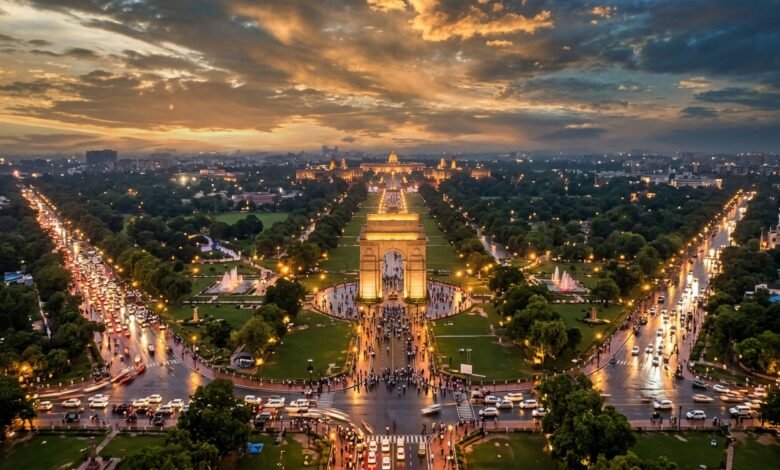
History is generous with examples of centuries that announced themselves from unexpected cities. Lisbon in the 1500s. Amsterdam in the 1600s. London in the 1800s. New York in the 1900s. The claim of this article is simple to state and demanding to defend: the twenty-first century’s next chapter — in trade, in artificial intelligence, in the culture that travels — could plausibly be written from New Delhi. Not by default, and not by copying anyone’s playbook, but because three lines are converging on the same map: BRICS’s institutional moment, India’s AI sovereignty bet, and the cultural confidence the world now calls the Bharat brand.
Line one: the economic machine that keeps compounding
Start with the least glamorous truth: scale plus growth plus stability is the rarest combination in development economics, and India is the only large economy holding all three. A five-trillion-dollar trajectory with six-to-seven per cent compounding, a median age near thirty, infrastructure adding airports and expressways at a pace no democracy has matched, and a banking system that survived the decade’s clean-up — this is the base layer of any century-claim. Within BRICS, the consequences are already visible: India is the member whose growth pays the bloc’s credibility dividend, whose digital rails others license, and whose demand now sets export budgets from Moscow to Mombasa. When the history of how the Global South built institutions that actually work is written, the New Delhi summits will get a chapter, and the growth numbers will be the footnote that makes it stick.
A century is not awarded. It is assembled — from growth, from rails, from trust, and from the willingness to build what nobody else will.
The Crescent World
Line two: AI with its own spine
The second line is the technology bet. While richer countries argue about AI, India is building it — compute as a national commons, foundation models trained on its own twenty-two languages, applications fused with digital public infrastructure that already reaches a billion people. The sovereignty doctrine is neither autarky nor dependence: it is optionality, the ability to deploy AI for a farmer’s crop photo and a district hospital’s telemedicine without asking anyone’s permission. And the export model is unmatched — no other country can hand the Global South a working stack of identity, payments, open commerce and multilingual AI at prices their budgets survive. Silicon Valley sells brilliance; India is selling capacity. In a century where capacity decides who modernises on their own terms, that is the more consequential product.
Line three: the culture that travels ahead of the passport
The third line is the least quantifiable and most durable: cultural confidence. Indian cinema charts globally without asking, yoga owns a UN day, the millet bowl sits in Berlin cafés, and the Global South consumes Indian culture as a preview of its own possibilities rather than as exotic entertainment. Culture compounds like interest: every film, festival and startup that succeeds abroad lowers the cost of the next one’s credibility. Empires used to export their worldview with gunboats; the modern version is an algorithm that decides a Telugu dance challenge is the next global sound — and New Delhi’s cultural balance sheet is compounding faster than any rival’s in the Global South.
The convergence, and what could break it
Each line alone is a strong decade. The century-claim rests on their convergence: an economy big enough to fund institutions, a technology stack independent enough to offer the world a second option, and a culture confident enough to make the offer welcome. Honest readers deserve the short list of what could break it: a jobs crisis that turns demographic dividend into demographic stress; federal and judicial friction that slows the reform pace to a crawl; a China border crisis that forces military spending over human capital; climate shocks that eat agricultural margins; and the permanent temptation of majoritarian politics to convert cultural confidence into cultural grievance. None of these is exotic — every rising power has met them, and history’s graveyard is full of centuries that were forecast and never built.
- The jobs test. Eight million young people enter the workforce annually; manufacturing and services must absorb them or the dividend turns to unrest.
- The institutions test. Courts, contracts and cooperative federalism decide whether growth is trustworthy at century scale.
- The neighbourhood test. A Global South leader needs a stable, prosperous periphery; South Asia’s integration remains the unfinished chapter.
- The climate test. Heat, water and monsoon volatility are the century’s tax on every Indian forecast — mitigation and adaptation are not optional lines in the budget.
Yet the direction of the three lines is the story. Trade data flows inward, compute hums at home, culture travels outward, and the Global South watches a country that looks like its own future rather than like a distant superpower’s. Lisbon, Amsterdam, London and New York each wrote their centuries by combining commerce, technology and cultural gravity before their rivals finished doubting them. The combination is on the table again — assembled this time in New Delhi, in a Hindi-Tamil-English blend the old capitals cannot fully parse, offered to a planet that is increasingly done with asking permission. Whether the next century is written here is now, honestly, India’s choice to lose.
Your take: which of the three lines — economy, AI, or culture — is India’s strongest century-card, and which is the weakest link? Make your case in the comments.
Read the two companion pieces: the economic engine — India’s BRICS Dividend: How Modi Is Positioning Bharat as the Global South’s Growth Engine — and the technology bet — AI Without Dependence: Modi’s Vision for a BRICS-Led Digital Future Beyond Silicon Valley.
Illustration generated with AI (Gemini 3.1 Flash Image) for The Crescent World.


