

BRICS Tourism Corridor: Can Modi’s Connectivity Vision Make India the Gateway to the Global South?

The idea of a “tourism corridor” sounds like ministerial poetry until the flights, visas and rail cards start multiplying. Then it becomes an economic strategy — and in 2026 it became one of India’s most quietly effective diplomatic products. A country that hosts BRICS ministers across thirty cities in a single chairship year, keeps its spiritual circuits moving tens of millions of pilgrims through rebuilt airports, and negotiates air-corridor expansion with the Gulf and Central Asia simultaneously is no longer just a destination. It is positioning itself as the gateway economy of the Global South. How close is that ambition to reality?
Three corridors, one strategy
The first and most publicised is physical: the India–Middle East–Europe Economic Corridor, the rail-and-maritime spine announced at the G20 and now being advanced with the US, UAE, Saudi Arabia, France, Germany, Italy and the EU across its eastern and northern routes. Tourism rarely leads IMEC’s headlines, but corridors move more than cargo — easier mobility between the Gulf, the subcontinent and Europe re-prices three tourism flows at once, from Gulf family travel to religious circuits to Europe-bound youth journeys.
The second is aviation, where the arithmetic is dramatic. The India–UAE air corridor is already among the world’s busiest; a Tourism Economics study projects its annual traffic nearing 25 million passengers by 2035, warning that current bilateral seat caps — Abu Dhabi carriers are capped at 50,000 weekly seats across 11 Indian cities — would strand tens of millions of travellers. Expansion talks are effectively forced by demand. North of the Gulf, new connectors are even turning Central Asia west-facing: direct Tashkent–Hyderabad flights launched in September 2026, and African routes remain the obvious next frontier of India’s gateway claim.
The third is institutional: the doorway itself. The eVisa system, UPI One World for foreign visitors, and an initiative from the 2025–26 budget to develop 50 top tourist destinations in partnership with states — with hotels formally classified as infrastructure to attract investment — all attack the friction that used to define India travel. Fifty-three regional UDAN tourism routes now stitch smaller airports into the national network.
India was never short of attractions. The corridors are finally delivering what was missing: ways in, and reasons to return.
The Crescent World
The BRICS layer: people-to-people superpower
New Delhi used its 2026 chairship to scale people-to-people connectivity with unusual seriousness — more than four hundred meetings, ministerial and citizen-level, spread across thirty Indian cities rather than locked into one capital. The New Delhi Declaration backs cultural exchange, and China’s proposed forum on services trade — tourism included — extends the commercial logic. For the Global South, the significance is practical: BRICS members and partners across Asia, Africa and Latin America now negotiate travel simplification inside a single institutional framework, with India both host and gatekeeper. Combine that with the bloc’s forty-per-cent share of world GDP and the corridor concept stops being metaphorical.
What the market says
The private numbers corroborate the state ambition. India’s travel market was valued at ₹5,972 billion — about $67.6 billion — in FY26, up 7.6 per cent, after three consecutive years of double-digit growth; online bookings have crossed 42 per cent penetration, and alternative accommodation was the fastest-growing segment. Lufthansa Group now calls India its second-largest intercontinental market worldwide — eleven flights daily from four hubs, including two daily A380s from Munich — and has launched a new Zurich–Bengaluru route aimed squarely at South India’s technology-traveller blend. Medical, spiritual and wellness travel add high-margin layers on top: the segments where a Global South gateway genuinely out-competes the North.
The honest frictions
- Airspace geopolitics. The Pakistani airspace closure, the West Asia conflict and the oil shock have lengthened Europe routes and inflated fares — two-thirds of airline costs are dollar-denominated, and the rupee’s slide has dented international segment growth.
- Fragmented permits. Overlapping inner-line permit regimes and uneven inter-state coordination in parts of India still break multi-state itineraries that operators want to sell.
- Capacity before rhetoric. Bilateral aviation agreements, which throttle how many visitors the Gulf and other corridors can carry, negotiate slower than demand grows — the UAE study’s projections are essentially a warning to negotiators.
The verdict so far: the components of a genuine Global South gateway — physical corridors, aviation capacity, visa reform, digital friendly-front-door infrastructure and institutional gravity — all exist and are measurable. What remains is integration: fewer broken itineraries, faster bilateral seat growth, and marketing that tells the world one coherent story. A decade from now, the measure of Modi’s connectivity vision will be simple — whether travelling across the Global South means routing through India, or at least through India’s rails, skies and payment rails behind it.
Your view. Is India on track to be the Global South’s travel hub — and which corridor matters most: IMEC, the Gulf air bridge, or the African routes? Comments are open, and share this with a travel dreamer.
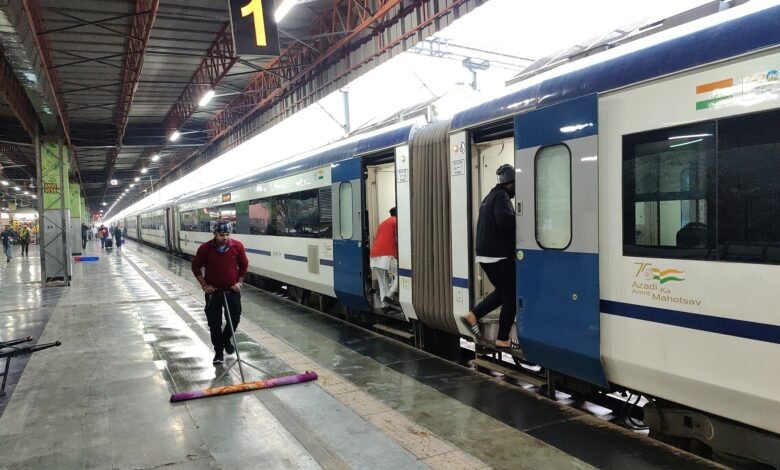
Featured image: the Vande Bharat Express at New Delhi railway station. Photo: Ravi Dwivedi (CC BY-SA 4.0), via Wikimedia Commons.


