

Feeding 1.4 Billion and Exporting the Playbook: India’s Climate-Smart Farming Turn

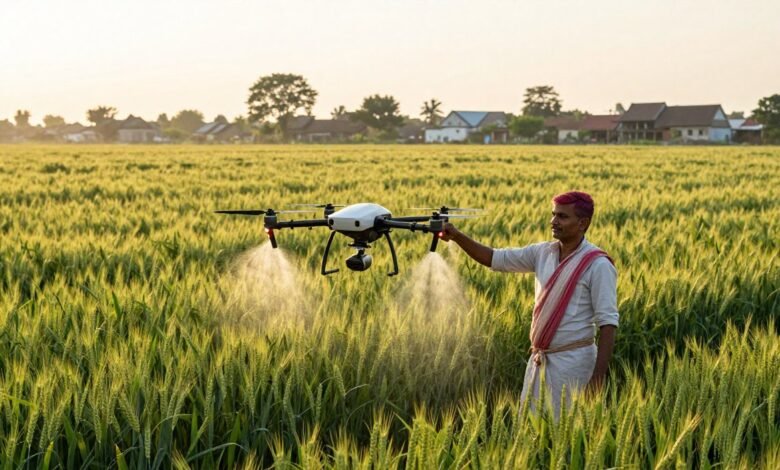
Feeding 1.4 billion people is the least glamorous, most consequential logistics operation on earth, and for most of its independent history India ran it just-in-time, crisis to crisis. That era is ending. A country once defined by ship-to-mouth dependence now runs the world’s largest food-security programme, holds buffer stocks that survived pandemic shocks, and has begun exporting something more valuable than rice: a farming playbook built for smallholders, monsoons and thin margins that the rest of the Global South is starting to copy.
The safety net that actually held
When the pandemic broke supply chains everywhere, India put free grain into the hands of roughly 800 million people through the world’s largest food-distribution operation — ration shops linked to digital identity, portable benefits that followed migrant workers across states, and procurement systems that bought from millions of small farms. The stocks held. The queues shortened. In an era when several wealthy countries saw empty shelves, the fact that the world’s most populous nation did not is a story with less fanfare than it deserves. The programme continues in its successor form, and its digital backbone — biometric authentication, portability, real-time stock dashboards — is the part other governments ask about first.
Food security is not a harvest statistic. It is a promise that survives a supply-chain shock — and India’s promise held.
The Crescent World
Climate-smart farming stops being a seminar topic
The production side is changing faster than most observers notice. Drones — many piloted by rural women trained under the Namo Drone Didi scheme — spray fields in minutes instead of hours. Digital crop surveys map plots satellite-by-satellite, ending the guesswork that made relief and insurance slow. Thousands of Farmer Producer Organisations give smallholders the collective bargaining power of a large farm. And a national mission on natural farming is pushing chemical-lite methods that cut input bills and rebuild soil, backed by a fertiliser policy that now rewards states for reducing overuse rather than only for distributing it.
- Farmer IDs at scale. With more than eleven crore digital farmer identities created ahead of schedule, credit, insurance and advisory reach the right plot instead of the loudest intermediary.
- Loans in minutes, not seasons. Digitised land records and account-aggregator data flows let Kisan Credit Card approvals shrink from field visits and weeks of paperwork to same-day decisions for verified farmers.
- Water under the microscope. Micro-irrigation expansion, solar pumps under PM-KUSUM and crop-diversification incentives push water-hungry paddy out of dry districts — quietly, one aquifer at a time.
- The blue economy joins the plate. Fisheries and aquaculture now contribute record production and exports, adding protein and livelihoods along 7,500 kilometres of coastline.
From buffer stocks to export leverage
Surplus became diplomacy. India’s grain exports, its breakfast-to-basmati supply chains and its emergency humanitarian shipments — from wheat to Afghanistan to rice for African food programmes — turned agricultural capacity into foreign policy. When export bans on non-basmati rice roiled world markets, they also demonstrated something uncomfortable but honest: India’s domestic food inflation is a political constraint no government will trade away, and the Global South noticed that a large producer will protect its own poor first. The lesson for other developing countries is double-edged — build the surplus, but expect to wield it.
Why the playbook travels
Africa and Southeast Asia face the same triad India did: small and fragmented holdings, monsoon dependence, and thin public budgets. India’s recent answers were built for exactly those constraints — digital public infrastructure over subsidy bloat, satellites over inspectors, producer collectives over middlemen, and drip lines over canal dreams. The African Development Bank and FAO delegations that tour Indian agricultural universities are not there for the tea; they are there for the implementation details of the world’s largest experiment in feeding a nation under climate stress.
The honest frictions
- Farms are still tiny. The average holding keeps shrinking with each generation; consolidation, leasing reform and cooperative machinery are moving too slowly to change arithmetic quickly.
- Water is the real deficit. North-western aquifers are falling despite efficiency schemes; the paddy-wheat cycle survives because procurement makes it rational to keep planting it.
- Income security remains unsettled. The price-support debate is unresolved, and farmer protests have repeatedly shown the political ceiling on reforms imposed without consensus.
- Nutrition lags calories. Grain security has largely been achieved; protein and micronutrient security have not, and the millet revival is a promising but early correction.
None of that dims the arc. A country that readers of a certain age associate with PL-480 imports now insures crops by satellite, sprays by drone, lends by algorithm and feeds 800 million people through a net that demonstrably held during the worst supply shock in a century. The Global South does not need to copy India’s politics to copy its methods. It needs to copy the sequence: digitise identity and records first, build procurement and storage second, modernise inputs third — and let the surplus, when it finally arrives, do the negotiating.
Your take: which piece of India’s food-security machinery would make the biggest difference in your country — digital farmer IDs, buffer stocks, or natural farming? The comments are open.
Read the companion piece: how digitisation reached the farm gate years before this harvest of reforms — Can India Feed the Future? Inside the Digital Agriculture Model the BRICS World Is Watching.
Illustration generated with AI (Z-Image Turbo, rendered locally) for The Crescent World.


