

Beyond the Dollar: Why India’s BRICS Play Could Become the Biggest Economic Story of the Decade

Few numbers capture how fast the ground is shifting beneath the global economy like this one. India’s trade with BRICS partners has more than doubled in five years — from $203 billion in 2020–21 to $417 billion in 2025–26. Behind that figure sits a quieter ambition that measures far more than commerce: the deliberate construction of a financial architecture that does not need the US dollar. After two summits dedicated to cross-border payments, and a year in which tariff wars and sanctions have made dollar dependence feel like exposure, this may be the biggest economic story of the decade. Here is what is actually being built — and what is only talk.
What BRICS has really constructed so far
Strip away the headlines about a “BRICS currency” — which no serious official pursues — and what remains is a stack of workable institutions and rails. The New Development Bank has funded green and infrastructure projects across members for a decade. The Contingent Reserve Arrangement sits beside it as a liquidity backstop. More consequential lately are the payments plumbing initiatives: the BRICS Cross-Border Payments Initiative launched in Kazan in 2024, carried through Rio in 2025, and advanced at the New Delhi summit in September 2026 through a continuing BRICS Payment Task Force. The group is now working on the pragmatic end of finance: linking domestic fast-payment systems, exploring interoperability between central bank digital currencies, and pushing for trade settlement in local currencies where it makes commercial sense.
India’s contribution to this architecture is distinctive because it already exists at retail scale. UPI — the world’s largest real-time payments system — is being connected abroad: live linkages with the UAE and Singapore, exploratory frameworks with France, Sri Lanka and others, and a proposal India pressed at the Delhi summit to link the fast-payments systems of BRICS members themselves. A merchant in Dubai navigating an Indian supplier’s invoice across rupee rails is not an abstraction; it is how a growing share of corridor trade already settles. That is de-dollarisation in its most honest form — not a headline currency, but a bypass lane.
The dollar will not be defeated in a Thunderdome. It will be bypassed — transaction by transaction, rail by rail.
The Crescent World
Why now: the sanctions-tariff squeeze
Motivation matters as much as machinery. The expansion of BRICS to 11 members and 10 partner countries has folded sanctioned economies and tariff-hit economies into the same room. The New Delhi Declaration condemned “indiscriminate rising tariffs” without naming the United States, and reaffirmed opposition to unilateral sanctions. Oil flows settled in non-dollar arrangements, central banks adding gold at historic pace, and the political scar tissue left by the freezing of Russian reserves have together made one lesson universal: reserve-currency dependence is now seen across the Global South as a strategic vulnerability, not a convenience.
The dollar remains the sea everyone swims in
Honesty requires the other half of the ledger. The dollar still accounts for close to three-fifths of global reserve holdings, dominates commodities pricing, and owns the deepest bond markets on earth — advantages that took a century to build and do not yield to a task force. BRICS settlement in local currencies remains the exception rather than the rule; the intra-bloc trade pattern is lopsided, with China looming over the flows and several members running structural deficits against it, which cannot be netted away in rupee-ruble accounting. Exchange rate regimes, capital controls and financial regulation differ wildly across the group. That is exactly why no BRICS common currency is on the table, and why initiatives like China’s proposed BRICS Special Economic Zone concept and a services-trade forum were left as ideas rather than treaties at New Delhi.
Where the decade is actually heading
- Payments rails, not reserve currencies. Watch the growth of local-currency settlement across BRICS corridors and the technical binding together of domestic payment systems — the quiet metrics that compound.
- Institutional follow-through. India’s proposed BRICS Continuity and Implementation Mechanism — a troika of past, current and incoming chairs tracking commitments — targets the bloc’s chronic habit of losing momentum between summits. Its first real test is the handover to China’s 2027 chairship.
- The investment layer. India’s chairship advanced the BRICS Economic Partnership 2030 strategy and a task force on growth and development; the New Development Bank’s next balance-sheet expansion will tell you whether development finance follows the rhetoric.
The verdict
Calling this “the biggest economic story of the decade” is not the same as predicting the dollar’s collapse — that prediction has a perfect losing record. It is a claim about direction. Forty per cent of world GDP now organises itself, summit after summit, around the principle that financial plumbing is geopolitical infrastructure. India, with the payments system the world actually scrutinises and the diplomatic capital it earned from a successful chairship, is positioned as the hinge member: credible to the West, embedded in the South, allergic to escalation. Every basis point that migrates from dollar-priced settlement into rupee, dirham, yuan or digital-currency rails is small on any given day — and enormous compounded over ten years.
The dollar is not being killed. It is being fenced in, slowly, by a parallel world being built in plain sight. Firms, investors and governments that treat that process as noise will discover, sometime in the 2030s, that they were watching the foundation being poured.
Have your say. Is de-dollarisation inevitable, a decade-long grind, or overrated? Put your position in the comments, and share this article with someone who follows the money literally.
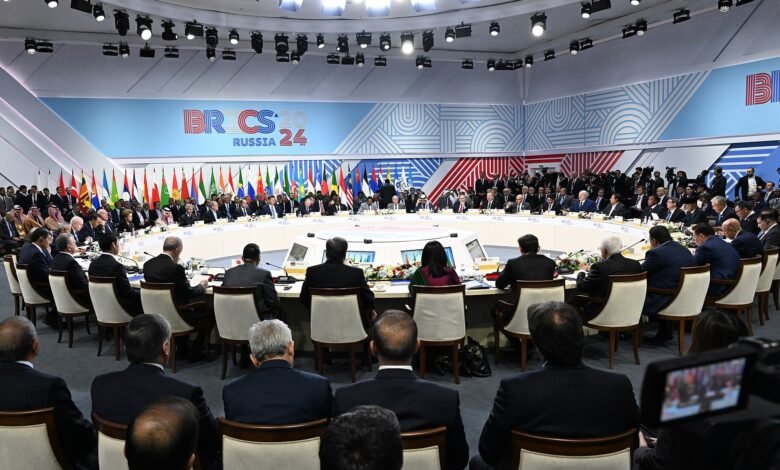
Featured image: the plenary session of the 2024 BRICS Summit in Kazan, Russia. Photo: Press Service of the President of the Republic of Azerbaijan (CC BY 4.0), via Wikimedia Commons.


