

Made in India 2.0: Smartphones, Toys, Defence and the Export Ledger That Stopped Being One Story

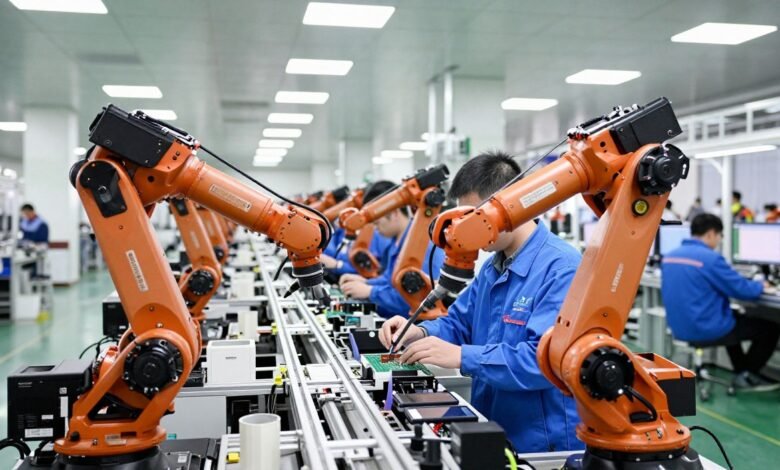
A smartphone assembled in Chennai lands in Chicago. A toy sewn in Noida sits on a shelf in Berlin. A BrahMos coastal battery deal in Manila gets photographed next to a “Made in India” stamp. These are not press-release lines; they are the visible edges of a structural change in how the world makes things — a change whose centre of gravity is quietly shifting toward India. For decades the country’s export story had exactly one hero: IT services. The newest trade data has a longer cast list.
The export ledger stopped being one story
Smartphones have become one of India’s top manufactured export lines, with shipments crossing tens of billions of dollars a year on the back of factories that did not exist a decade ago. Electronics overall, pharma, agricultural machinery, medical devices and defence platforms are all growing in the same fiscal years. Merchandise exports to new destinations — West Asia, Africa, Latin America — are rising even as traditional Western markets stagnate. When growth is this broad-based, it stops being an isolated success story and starts being a system.
One export champion makes a headline. Seven moving together make a manufacturing base.
The Crescent World
How the incentives actually worked
The Production Linked Incentive idea was simple to the point of suspicion: pay companies only for output that ships, in sectors the country logically should be owning — electronics, medical devices, drones, solar modules, advanced chemistry batteries. It broke the familiar pattern of subsidy without accountability because the money flowed through customs and sales data, not through ministerial discretion. The result: anchor plants added inside two budget cycles instead of five, and the “assembled in India” label grew genuine local value as component suppliers followed the anchor factories in. What began as an iPhone assembly play is maturing into a components ecosystem — enclosures, chargers, displays, then progressively higher-value boards.
Case studies the world is studying
- Electronics. A handful of anchors and their supplier parks turned India from a handset-importing market into one of the world’s largest phone producers, with export volumes that have rewritten customs forecasts across Asia.
- Toys. A policy cluster — quality-control orders, duty walls against dumping, cluster parks — did not just protect Indian toymakers, it turned some of them into brands selling abroad. Toy exports multiplied several-fold in five years.
- Defence. BrahMos, Pinaka and Akash orders from the Philippines, Armenia and beyond turned the world’s largest arms importer into one of its fastest-growing exporters, with a defence-production record and an export target that no longer sounds fanciful.
- Semiconductors. The first fabs and packaging plants under the India Semiconductor Mission — from Sanand to Dholera to Jagiroad — are moving from construction hoardings to cleanrooms, aimed at the boring but strategic middle of the chip chain: mature nodes and assembly, where volume lives.
Why Global South countries care
India did not follow the East Asian playbook of currency suppression, single-party discipline and imported repression. It built manufacturing through a federal democracy with courts, protests, coalition politics and a free press intact. For governments in Africa and Southeast Asia, that is the useful detail: a template that survives elections and judicial review is a template that can actually be implemented at home. The sequencing is also instructive — infrastructure first through the Gati Shakti master plan and the National Logistics Policy, incentives second, trade agreements third. Cheap power, expressways and digitised customs came before the subsidies; that order is why the factories could ship the day they opened.
The labour story is changing too. Codes consolidating decades of industrial law, apprenticeship expansion and the PLI’s employment linkage are nudging firms toward formal hiring at scale. Female factory participation in electronics parks — once a rounding error — is becoming a selling point that state governments now compete over.
The honest frictions
- Tariff walls cut both ways. Import substitution for components still prices some Indian exports out of deep value chains; incentives mature a sector but do not repeal comparative advantage overnight.
- Labour law complexity persists. Firms still hire cautiously because retrenchment rules vary by state; the expansion is real but staffing lags parallel Asian capacity.
- The scale elephant. Even at current growth rates, manufacturing’s share of GDP is rising from a modest base — the story is trajectory, not victory lap. China’s share of global manufacturing remains several times larger.
- Depth beats assembly. The gap between final assembly and genuine design-and-build — semiconductors, machine tools, aviation-grade components — is where the next decade’s policy battle sits.
Measured against its own past, though, the shift is unmistakable. A decade ago the polite compliment was “world’s back office”; the newest data says “world’s fast-growing workshop” is becoming the accurate one. India is not replacing anybody’s factories — it is adding capacity where none existed, at scale, inside a noisy democracy. Planners elsewhere do not need to copy the slogans. They need to copy the sequencing: incentives tied to shipped output, logistics fixed before subsidies flow, and exports as the only scoreboard that matters.
Your take: which sector’s rise surprises you most — electronics, toys, defence or semiconductors? And what did India get right that your government keeps missing? The comments are open.
Read the companion piece: how Indian economic strength mutates into financial diplomacy — Beyond the Dollar: Why India’s BRICS Play Could Become the Biggest Economic Story of the Decade.
Illustration generated with AI (Z-Image Turbo, rendered locally) for The Crescent World.
Related reading: The rupee’s $6 billion comeback and Why India stopped exporting battery scrap.
n


