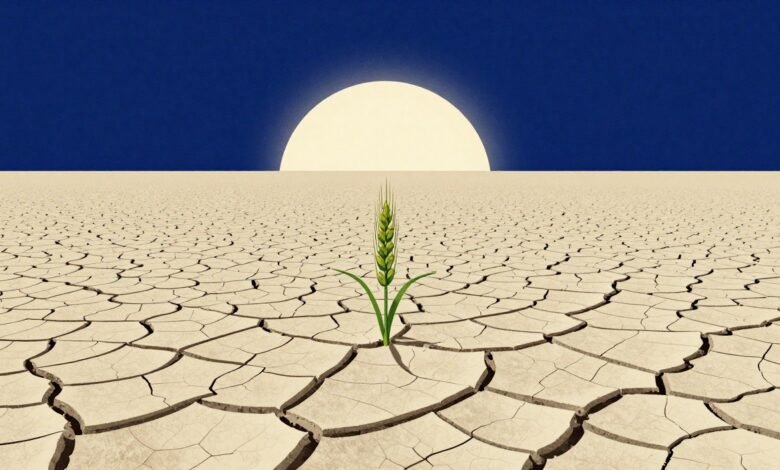
Telangana is preparing a five-month, ₹10,000 crore El Niño preparedness programme that would spend nearly ₹2,000 crore every month after Sankranti, according to The Hindu. The plan, conceptualised by Chief Minister A. Revanth Reddy, will be a centrepiece of the Telangana Climate Conclave, part of the Telangana Rising Global Investment Summit.
The headline number is large. The intent is more important. This is not a compensation package announced after a crop failure. It is an attempt to build drought resilience before the next shock, through works that can be measured: tanks, streams, canals, groundwater recharge, rainwater harvesting and rural conservation.
What the Programme Will Do
The Irrigation and Panchayat Raj departments will jointly implement the programme. Works are expected to begin after Sankranti and run for five months, with about ₹2,000 crore deployed each month. The focus is on rejuvenating tanks, streams and canals, improving groundwater recharge and expanding rainwater harvesting across rural Telangana.
That mix makes sense in a state where water storage is both an agricultural input and a rural employment asset. Desilting a tank, repairing a canal or building a recharge structure creates work in the agricultural lean season. If the work is done well, it also improves the next crop’s odds.
Climate adaptation is most credible when it shows up as a repaired tank before it shows up as a compensation cheque.
Why El Niño Is a Water Problem
El Niño does not affect India through a single switch. It changes the odds of rainfall, often weakening the monsoon and leaving uneven spatial distribution. For a state dependent on tanks, canals and groundwater, the danger is not only less rain. It is less rain arriving at the wrong time, in the wrong places, after years of over-extraction.
Telangana’s programme therefore treats water as a system. Recharging groundwater reduces dependence on pumping. Restoring tanks spreads storage across villages rather than concentrating it in large projects. Rainwater harvesting in rural areas can reduce runoff and improve local availability. These are older ideas, but they work because they are close to the point of use.
The Conclave and the Credibility Test
Irrigation Minister N. Uttam Kumar Reddy has directed officials to keep the climate conclave focused on practical, scientifically established solutions. He specifically asked for globally recognised climate-resilience models and best practices, including those identified by the International Crops Research Institute for the Semi-Arid Tropics, or ICRISAT.
That is a sensible instruction. Climate conclaves can easily become exhibitions of adjectives. The value lies in translating evidence into district plans: which tanks need desilting first, which watersheds show falling groundwater, which mandals need job work in the lean season, and how outcomes will be measured.
India’s wider climate debate has moved in this direction. Our coverage of the COP31 fossil finance draft has focused on who pays for transition, while rice methane emissions shows how agricultural choices sit inside climate commitments. Telangana’s programme is the local version of the same argument: adaptation has to be funded, not merely recommended.
Jobs Are Not a Side Benefit
The programme is expected to generate employment during the agricultural lean season. That deserves to be treated as a core objective, not a footnote. Rural works that begin after Sankranti can absorb labour when farm activity slows, supporting incomes while building assets that raise future productivity.
The design challenge is to avoid a rush of low-quality works. A tank that is desilted without a maintenance plan will fill again. A recharge structure dug without hydrogeological input may do little. A works programme that pays wages but ignores asset quality will satisfy one objective and fail the other.
What to Watch
Four indicators will show whether the ₹10,000 crore translates into resilience. First, a district-wise list of water bodies and recharge works. Second, published wage and employment data for the lean season. Third, groundwater and reservoir trends before and after the works. Fourth, a maintenance responsibility map for every completed asset.
Telangana already has experience with large welfare and employment programmes. The next test is different: can it spend quickly without diluting the science? If it can, the model may be relevant well beyond the state. India’s reservoir and rabi sowing pressures show why climate preparation cannot wait for an official drought declaration.
Also read: COP31’s finance draft is where climate promises meet money and why reservoir levels already shape the rabi crop.
Source: The Hindu, “₹10,000 crore five-month programme planned to prepare Telangana for El Niño,” 24 November 2026.