

India’s AI Moment: Can Modi Turn BRICS into the Global South’s Answer to Silicon Valley?

When Prime Minister Narendra Modi stood at Bharat Mandapam in September 2026 and warned that the “weaponisation of technology” would define the next century, he was addressing a room that included the leaders of almost every major non-Western power on earth. Six months earlier, in the same venue, his government had convened one of the largest AI gatherings in history — a summit that drew more than a hundred countries, a Guinness World Record, and over $200 billion in investment pledges. The question in the air at both events was the same: can India turn its scale, digital rails and frugal engineering culture into the Global South’s answer to Silicon Valley?
The machine behind India’s AI moment
The foundations were laid methodically. The IndiaAI Mission, launched in March 2024 with an outlay of roughly ₹10,372 crore, has in under two years assembled what India calls common compute: more than 38,000 GPUs made available to startups and universities at subsidised rates, with another 20,000 announced at February’s summit. Twelve consortia — including Sarvam AI, Soket AI, Gnani AI and the IIT Bombay-led BharatGen project — are building indigenous foundation models trained on Indian languages and datasets, with compute costs funded by the state. A national datasets platform, AI Kosh, gives controlled access to India-scale data.
Then came the show of force. The India AI Impact Summit in February 2026 drew 20 heads of government, 59 ministers and delegations from over 100 countries to New Delhi; around six lakh people attended in person. The New Delhi Declaration on AI Impact was endorsed by 92 countries and organisations — including the United States, China, the UK and France — around seven pillars with deliberately accessible names: democratising AI resources, AI for social good, resilient systems, human capital. Global CEOs put numbers on the optimism: Reliance pledged $110 billion toward AI infrastructure over seven years, Adani promised $100 billion by 2035, Tata announced a partnership with OpenAI on AI-ready data centres, and Google committed to a $15 billion AI hub in Visakhapatnam alongside new subsea cable routes.
India is not trying to out-spend Silicon Valley. It is trying to out-share it — and the Global South is the audience that matters.
The Crescent World
Why the model is different — and why BRICS is the podium
India’s AI pitch is not frontier supremacy at any cost. It is AI as public infrastructure — the same doctrine that produced UPI and Aadhaar, applied to compute, data and models. Where American labs optimise for capability and Chinese policy optimises for state control, India is optimising for distribution: 22 official languages trained into the models themselves, open-source commitments, and deployment channels already running at population scale in welfare, agriculture and public health. That is why the BRICS platform matters to New Delhi. The Delhi Declaration adopted in September 2026 — 140 points agreed by 11 members and 10 partner countries — carries a full throated section on AI: cooperation on accessibility, safety and “trustworthy” systems, an explicit nod to India’s February summit, and a shared insistence that AI benefits not concentrate in a handful of Northern firms. Modi’s sharpest line went further, flagging the “weaponisation of technology and critical minerals” as the threat the Global South must unite against.
The contrast with the other two AI superpowers is the point. Washington’s approach runs through export controls and capital moats; Beijing’s through state-coordinated champions. India’s offer to the Global South is a third route: shared compute facilities, open datasets, interoperable identity and payment rails, and models small enough to run cheap. The Global AI Impact Commons launched at the February summit — eighty-plus use cases across thirty countries, replicable rather than proprietary — is the template in miniature.
Case studies already running
- Agriculture. AI-based advisory engines built on state digital-farming registries now push weather, pest and price advice into farmers’ phones in local languages — Maharashtra’s MahaVistar is the flagship, replicated by other states.
- Accessibility. At the summit expo itself, an open-source handheld device recognising objects by voice in multiple languages — built with the Bhashini translation stack — was released to the startup ecosystem for refinement.
- The rails beneath it. Roughly 80 per cent of food-court transactions at the AI summit were made through UPI — the payments infrastructure quietly proving that India’s digital public goods are the distribution layer for whatever the models produce.
What would make it the real thing
“Answer to Silicon Valley” should be read precisely. India is not going to out-train the largest frontier models on American budgets, and it does not intend to — compute economics and export controls make that a losing game. What would constitute success is narrower and more achievable: the default AI stack for a hundred developing countries; Indian-language models competitive in their niches; a workforce exporting AI services the way it once exported business software; and a seat at the rule-making table for global AI governance, which the 92-country declaration demonstrates. On those terms the early results are remarkable for a 24-month-old mission.
The honest frictions
- Hardware dependence. GPUs, cloud capacity and networking equipment still come from abroad — the choke point India’s semiconductor mission is racing to relieve, but not yet relieved.
- Energy and land. AI-scale data centres need power and cooling at a moment when Indian cities are already grid-stressed; the new hubs in Visakhapatnam and elsewhere will be tested on both.
- Depth of capital. Pledges are announcements; converting them into revenue-generating products depends on enterprise buyers that Indian AI companies are still winning over.
None of these, however, changes the direction of travel. The combination India assembled — state-built rails, a billion-user market, engineering scale and a diplomatic coalition of 92 signatories — did not exist two years ago. If the current trajectory holds through the decade, the “India AI moment” will be remembered less as a summit season and more as the point when the Global South stopped waiting for permission to build its own digital future.
Your turn. Can India genuinely anchor AI for the Global South, or will Silicon Valley and China keep the crown? Tell us your verdict in the comments, and share this piece with someone tracking the global AI race.
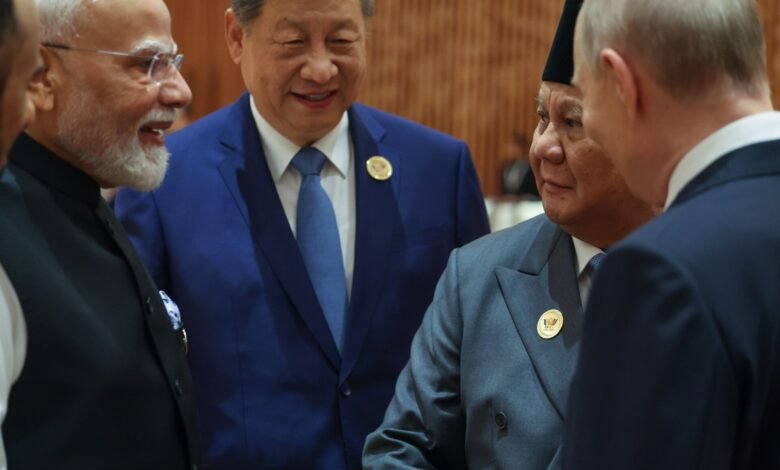
Featured image: BRICS leaders at the 18th BRICS Summit, Bharat Mandapam, New Delhi. Photo: Prime Minister’s Office, Government of India (GODL-India), via Wikimedia Commons.


