


Regional orders are built by the strongest local power, and in South Asia and the Indian Ocean, that power is India. When India decides on border doctrine, water treaties, naval deployments or financial support packages, neighbor states recalculate within days. The recent past shows the pattern vividly: from the May 2025 India-Pakistan confrontation to the reset with the Maldives, from Sri Lanka’s new government to China’s border diplomacy, geopolitical shifts in and around India trace out the scale of its impact on regional stability.
Deterrence rebalanced: the May 2025 crisis with Pakistan
The clearest demonstration of India’s changing regional role came in April and May 2025. After the terrorist massacre of twenty-six civilians near Pahalgam in Jammu and Kashmir, India moved within days to a new doctrine. On the night of 7 May, its forces struck nine sites in Pakistan and Pakistan-administered Kashmir in Operation Sindoor — a direct, named response crossing thresholds previous administrations avoided. Pakistan’s retaliation led to a heavy exchange, and a ceasefire followed on 10 May after direct military-to-military contact between the two sides’ Directors General of Military Operations. Two further escalations followed that remain consequential regardless of events on the border: India placed the Indus Waters Treaty — in force since 1960 — in abeyance for the first time in its history, and shut down commercial air links between the two states. Domestic and international observers agree on the core message: the cost-benefit math that governed cross-border terrorism has been rewritten by India’s willingness to escalate and to pay the reputational price.
“This is not an era of war.”
Prime Minister Narendra Modi’s line at Samarkand in 2022 — the phrase New Delhi keeps invoking even as its deterrent posture hardens
Neighbourhood recalculation: five countries, five adjustments
- Bangladesh. The August 2024 change of government in Dhaka unsettled bilateral politics, with friction over trade and the status of former prime minister Sheikh Hasina in exile. Yet India has calmed the relationship by prioritizing people- and economy-linked cooperation — power, rail and transit — because Bangladesh’s own trade math makes an India break expensive.
- The Maldives. President Mohamed Muizzu’s “India Out” politics of 2024 proved unsustainable: within a year of taking office, his government sought and accepted Indian financial support during its debt difficulties, and returned to coordinating maritime security with Delhi. The episode became a regional lesson in the practical limits of distancing from India.
- Sri Lanka. President Anura Kumara Dissanayake’s September 2024 election could have produced crisis. Instead, he chose India for his first bilateral visit within weeks of taking office, reaffirmed Colombo’s standing commitment that its ports and territory will not be used against India’s security interests, and prioritised development cooperation with Delhi.
- Nepal and Bhutan. Energy diplomacy binds these Himalayan neighbours to India’s grid and payments systems, while China-linked infrastructure projects operate under watchful Indian engagement.
- Afghanistan. India’s pragmatic engagement with the Taliban government — beginning with New Delhi hosting a Taliban delegation and expanding aid — shows India treating de-facto realities as a natural part of regional diplomacy, even as formal recognition stays cautious.
The India-China equation: managing the giant next door
No factor shapes Indian foreign policy more than the India-China relations question. The decisive stabilization point was the October 2024 disengagement agreement over the boundary, which restored pre-2020 patrol patterns at Depsang and Demchok — the flashpoints that had shut down relations since the Galwan Valley clash. The 2025 aftermath was visible and measurable: continued senior-level meetings, restored direct flights between Indian and Chinese cities, and the resumption of Kailash Mansarovar pilgrimage travel. Trade now crosses $120 billion a year, heavily tilted in China’s favour, giving Beijing both the test of India’s balance-of-payments resilience and the argument for New Delhi’s cautious supply-chain diversification strategy. For regional stability watchers, the takeaway is that neither economy wants war — but the boundary issue remains the single biggest structural risk to peace in Asia, and India’s deterrence-first management of it is what keeps the probability of large-scale war down rather than up.
Maritime stability: the Indian Ocean as India’s working room
India’s second pillar is the sea. The Indian Ocean carries roughly half of the world’s container traffic and a majority of China’s imports; keeping it open is essential to India and the wider trading world alike. The work is real rather than rhetorical:
- Anti-piracy and escort operations. From late 2023, the Indian Navy responded to attacks on commercial shipping near the Gulf of Aden and the Arabian Sea, escorting dozens of merchant vessels and conducting operations that ranged multiple hundred nautical miles from home ports — including the rescue of hijacked crews. The Navy’s message — provide security because trade depends on it, not because a bloc orders it — has earned it a following among merchant fleets.
- Local network-building. Mauritius, Seychelles, Sri Lanka and the UAE have been drawn into India-linked arrangements — radar facilities, port access, the Colombo Security Conclave — that quietly embed Indian security cooperation into a regional architecture no adversary need trust but all must account for.
Why India’s regional role is stabilizing overall
A fair reading of the evidence distinguishes between Indian power and Indian practice. The May 2025 operation against Pakistan was warfare; but its underlying purpose was to restore the campaign tolerance barrier, not to continue hostilities — days of war after decades of absorbing mass-casualty terrorism without strategic response. On China, stabilization came through an agreement India spent three-plus years of military-on-military talks pushing into existence. In the neighbourhood, Delhi provides crisis finance, energy and connectivity that neighbours cannot obtain from Beijing on comparable terms, while conspicuously not exporting ideology. The result is a regional order whose instability has grown, on the margins, mostly where India’s writ is weakest — Yemen-side shipping routes, Myanmar’s civil war, and the zone between armed non-state actors and state sponsors — and whose shared security partly rests on Indian maritime presence.
For the wider global map, India’s regional conduct functions as a preview of its systemic role — the same pattern that powers India’s global influence: rule-framing power, incentivising peace, but able to fight short, sharp campaigns when deterrence fails.
Have your say. Is India’s harder edge in South Asia delivering a more stable region — or storing up the next crisis? Offer your view in the comments, and share this article if it gave you a clearer picture of the neighbourhood.
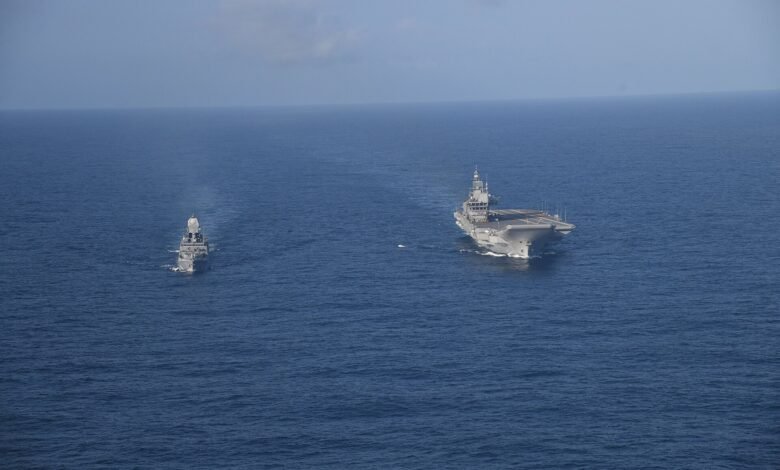
Lead image: India’s first indigenous aircraft carrier INS Vikrant sailing with a destroyer during sea trials. Photo: Indian Navy, via Wikimedia Commons (GODL-India licence).


