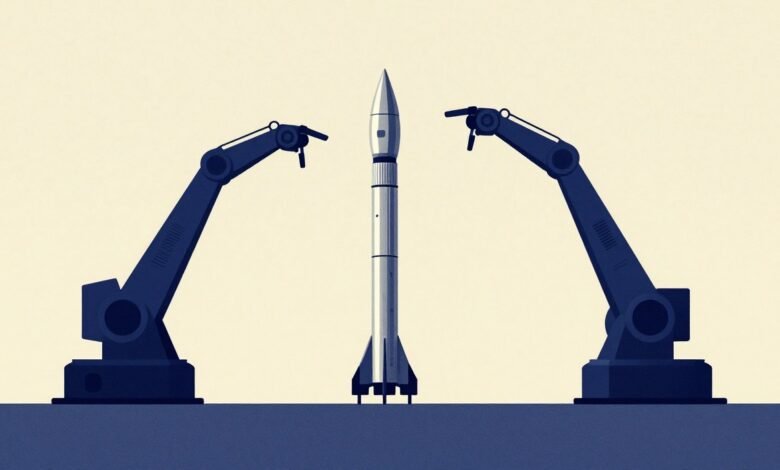
The ship did not land. It was caught. On Saturday afternoon, 171 feet of stainless steel descended over the Gulf coast, slowed to a hover beside the launch tower at Starbase, and was held by the same chopstick arms that catch the booster. It was the first time an upper stage from an orbital-class rocket had returned to its launch pad.
The flight had begun on Friday at 5:47 pm Eastern, from a Texas site operating while American aviation was still recovering from a nationwide ground stop. Rockets use different tracking from aircraft, so the launch went ahead. Twenty-two and a half hours and fourteen orbits later, the vehicle came home.
What flew
The upper stage, which SpaceX calls the ship, reached roughly 260 kilometres and released a batch of Starlink satellites. That is now routine. The return was not.
The satellites are the commercial point of the flight. Each launch adds capacity to a constellation that now carries a meaningful share of the world’s internet traffic, and the company’s revenue depends on cadence rather than on spectacle. A ship that can be recovered is a ship that can be inspected, and a ship that can be inspected is a ship that can fly again in weeks rather than months.
Re-entry put the heat shield through temperatures reported above 2,000 degrees Fahrenheit, in the range where tile loss becomes fatal. The vehicle survived, which is a statement about the tiles as much as about the guidance. Every previous flight that reached this point ended in the water or in pieces.
The booster that did not come back
Super Heavy, the first stage, was supposed to be caught minutes after launch. One of its 33 engines failed, and SpaceX aborted the catch, diverting the booster to a splashdown in the Gulf. The company described the outcome as a successful demonstration of its contingency path, which is true and also a way of saying the primary plan did not run.
Losing one engine out of 33 sounds trivial. It is not, at the moment of landing. A booster returning to the tower has to hold a precise position while engines relight and throttle; the margins are set by how many engines can be relied on. One engine out changes the arithmetic of the hover, and the safe answer was to send it to water.
Catching a ship is an achievement. Reusing one is a business.
The Crescent World
What the catch proves
It proves control. The tower has no landing legs to absorb error and no runway to forgive it. The ship had to arrive at a point in the sky within metres, at low speed, with the arms closing at the right instant. That is a guidance problem solved in public.
What it does not prove is reuse. A caught vehicle is a recovered vehicle. Turning it into a flown-again vehicle requires inspections of thousands of tiles, an engine check that takes weeks, and a refurbishment process nobody has yet run at this scale. The economics of Starship depend on a number — flights per ship per year — that this mission did not produce.
The Moon contract behind it
SpaceX’s next milestone is not another catch. It is a docking demonstration: a Starship test article meeting a NASA vehicle in orbit to rehearse the manoeuvres a lunar lander will need. That work is the reason the company has a contract to put astronauts on the surface, and it is behind schedule.
Catching the ship matters to that programme because a lander has to be refuelled in orbit, and refuelling requires ships that fly often. Every step that makes the vehicle ordinary makes the Moon architecture cheaper. Every step that remains a spectacle keeps it expensive.
The refuelling demonstration is the part that has no precedent at this scale. Moving cryogenic propellant between two vehicles in orbit, repeatedly, is a problem of fluid dynamics and thermal management that no one has solved commercially. The catch is photogenic; the transfer is the engineering.
Why India should care
India’s launch industry has built its case on cost per kilogram, a genuine advantage earned by small vehicles and efficient operations. The private space sector’s growth has been financed on that premise.
Full reusability attacks the premise directly. If a super-heavy launcher can be recovered, inspected and flown again, the price of moving mass to orbit falls for everyone, and the small-launcher niche becomes a taxi service to a station rather than a route to space. Indian firms will still find work — in satellites, in components, in analytics — but the launch market they entered is being repriced above them.
What to watch
Three things. Whether the caught ship flies again, and how quickly. Whether the booster catch returns on the next attempt, because a system that catches one stage and ditches the other is half a system. And whether the docking demonstration happens on the timeline NASA needs, because the Moon programme’s schedule is now the strongest external check on SpaceX’s claims.
For a decade the company has been accused of promising the future and delivering a test flight. On Saturday it delivered something narrower and more useful: a vehicle that came back to the place it started. The next flight will decide whether that was a stunt or a routine.
Illustration generated with AI (Z-Image Turbo, rendered locally) for The Crescent World.