


When Goldman Sachs economist Jim O’Neill coined the “BRIC” acronym in 2001, it was an investment thesis, not a diplomatic project. Today, the expanded BRICS — Brazil, Russia, India, China, South Africa, plus new members such as Egypt, Ethiopia, Iran, the UAE and Indonesia, with a growing list of “partner” countries — accounts by most estimates for roughly 45% of the world’s population and more than a third of global economic output in purchasing-power terms. BRICS relations among emerging economies have become one of the most consequential — and most misunderstood — features of contemporary geopolitics.
This article explains what the grouping actually builds, what its expansion changed, and why BRICS relations matter for the future of the world economy.
From investment slogan to institution
The transformation began modestly: a first leaders’ meeting in Yekaterinburg in 2009 (before South Africa joined in 2010), then a slow-building lattice of cooperation. The durable results include:
- The New Development Bank (NDB). Headquartered in Shanghai and launched in 2015, the NDB has approved tens of billions of dollars in infrastructure and sustainability projects and admitted non-BRICS members such as Bangladesh, the UAE and Egypt — evidence that the bank outgrew the acronym.
- The Contingent Reserve Arrangement. A $100 billion liquidity pool functions as a partial insurance policy against balance-of-payments shocks for members wary of IMF conditionality.
- Local-currency trade and settlement. Trade between members increasingly moves outside the dollar system. At the July 2025 Rio de Janeiro summit, leaders put their weight behind a BRICS Cross-Border Payments Initiative, and pilots of the wider “BRICS Pay” concept continue.
- Practical cooperation. Vaccine research and production cooperation, agricultural information systems, customs cooperation and technology-transfer networks — less headline-grabbing than currency politics, but lower-risk and quietly effective.
What expansion actually changed
The 2024–2025 enlargement was designed to strengthen BRICS ties among emerging economies — and it did, in measurable ways. First, it changed the geography of the bloc: with the UAE, Saudi Arabia (a still-unconfirmed invited member), Egypt, Ethiopia, Iran and Indonesia, BRICS now straddles the energy chokepoints of the Persian Gulf, the Suez Canal and the Malacca Strait. Second, it changed the math: the expanded economic weight gives the group real leverage in commodity markets and in instrument design, from grain exchanges to payment systems. Third, it introduced the “partner country” tier, letting countries such as Malaysia, Thailand, Vietnam and Kazakhstan affiliate without full membership — a pragmatic answer to the divergent risk appetites inside the bloc.
Critics note the asymmetry: China by itself represents the bulk of the group’s economic weight, and several new members are simultaneously deepening security ties with Washington. BRICS is therefore best understood not as an anti-Western alliance but as a coordination platform for economies that want options — a forum where India can share a declaration with Moscow and Beijing while also hosting naval exercises with the United States the same month.
The incentives: why emerging economies keep coming
- Insurance against sanctions and volatility. The freezing of Russian reserves in 2022 convinced many capitals that reserve diversification and non-dollar settlement are prudent, not radical.
- Infrastructure finance without conditionality drama. The NDB’s project approval processes, run on the principle of consultation rather than prescription, are attractive to governments that find IMF structural programs politically impossible.
- Voice and vote. BRICS membership is the loudest available platform for reforming dollar-centric trade, Western-dominated financial governance and an unreformed UN Security Council — a cause India and Brazil champion explicitly.
“BRICS is becoming the backbone of a multipolar world order.”
President Vladimir Putin, addressing the leaders’ summit in Kazan, October 2024
Russia’s framing overstates the case — for India, in particular, BRICS is not an anti-dollar project. External Affairs Minister Jaishankar has said publicly in 2025 that India has “never been for an anti-dollar policy,” and Delhi wants the grouping focused on development cooperation, artificial-intelligence governance frameworks, climate-finance equity and trade reliability rather than on confrontation with the West.
The constraints everyone should understand
Three structural limits will shape BRICS relations in the coming years. First, internal rivalry: the India-China border dispute does not disappear at the summit table, and the October 2024 disengagement agreement was a stabilizing event, not a resolution. Second, the tariff environment: the US has openly threatened BRICS members with higher tariffs, a pressure India is managing carefully during its 2026 chairmanship. Third, coordination costs: the more members the bloc adds, the harder consensus becomes — the very feature that helps expansion dilutes the ability to act as a bloc.
Why this matters for the world economy
The significance of BRICS relations among emerging economies is cumulative rather than revolutionary. Each summit adds mechanisms — a payment initiative, a grain reserve, a science framework — that reduce members’ dependence on Western-run infrastructure at the margin. Multiply those margins across a decade and across 45% of humanity, and BRICS becomes the slow-motion restructuring of global economic governance. With India holding the chairmanship in 2026 and hosting the summit on its own soil, expect the next chapter to emphasize digital public infrastructure and market-friendly cooperation over headline currency rhetoric.
Join the discussion. Do you see BRICS developing into a genuine alternative economic bloc — or a talk shop with good press? Share your reasoning in the comments below, and pass this article to anyone who still thinks BRICS ended in 2010.
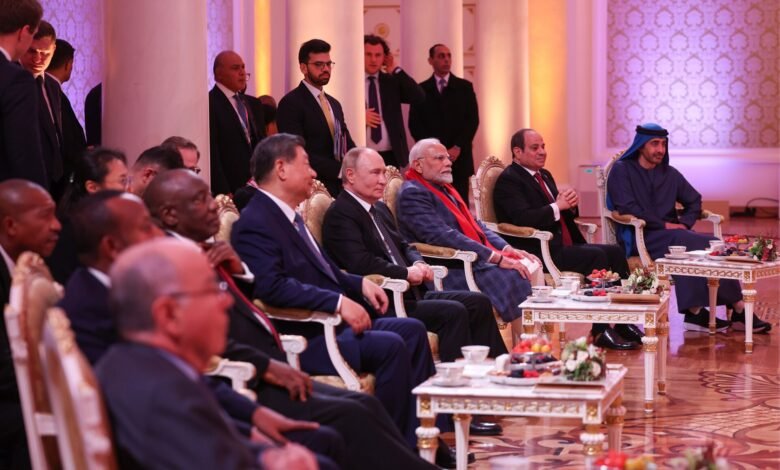
Lead image: Leaders of BRICS member states seated together at a summit dinner during the Kazan, Russia meetings (October 2024). Photo: Prime Minister’s Office, Government of India, via Wikimedia Commons (GODL-India licence).


